Luxury Bathroom Ideas: How to Build a Calm, Spa-Like Retreat at Home
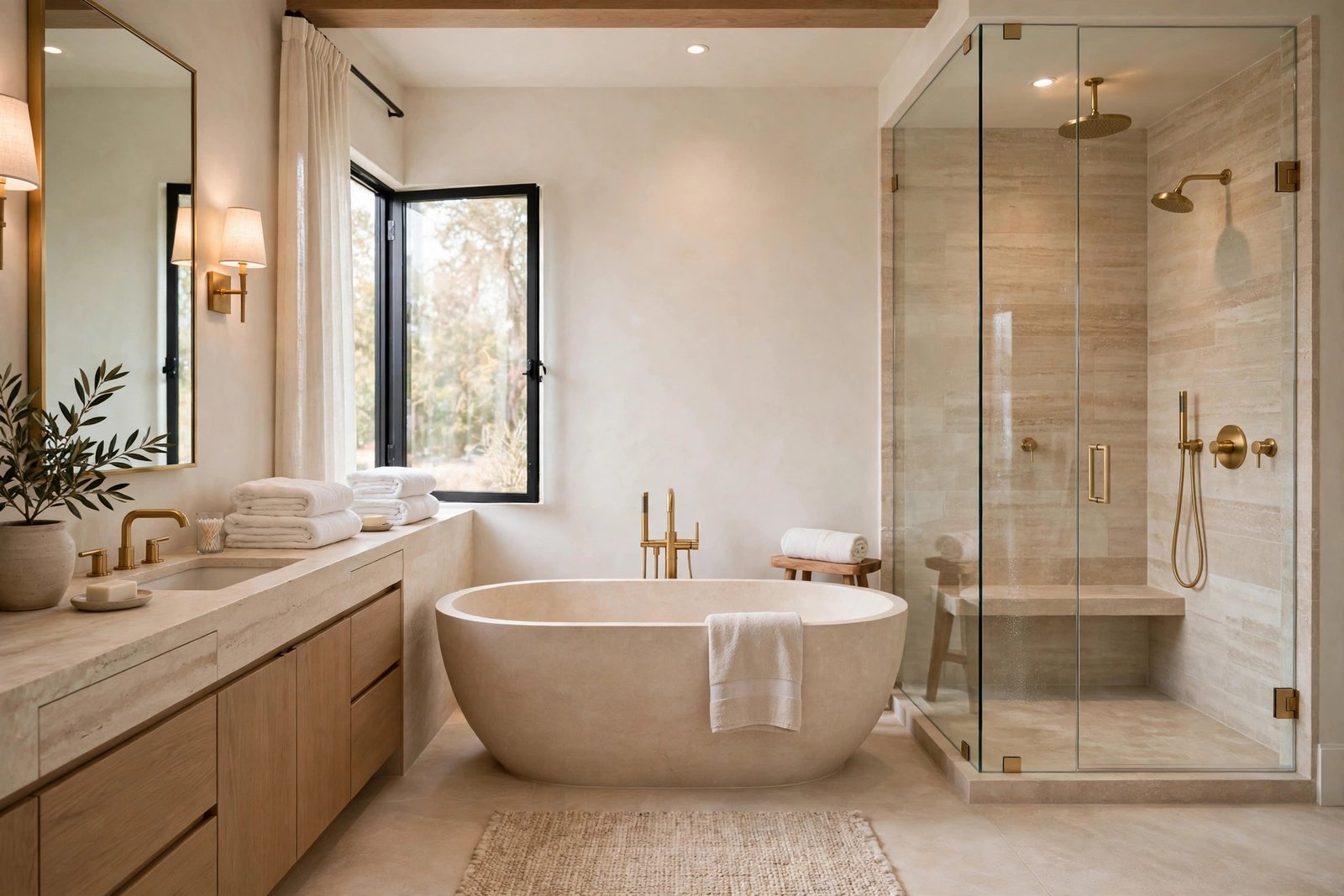
A luxury bathroom is a calm, well-planned room with quality materials, good light, one strong focal point, and clear surfaces. It is not simply an expensive room. A small bathroom with matching finishes and warm light can feel more luxurious than a large room with mismatched fixtures and cluttered counters.
That is good news. You do not need a huge room or a full remodel — just a clear plan and a few choices made well.
One honest limit up front: heated floors, curbless showers, and steam showers fit a remodel far better than a quick refresh, since they often need work under the floor or behind the walls. For those jobs, hire a licensed professional.
What Makes a Bathroom Feel Luxurious?
Luxury in a bathroom comes from a handful of signals your eyes read in seconds. The first is calm: a restrained color palette, usually two or three colors that work together.
The second is cohesion. The metal finishes match, the towels match, and the style of the faucet matches the style of the mirror. When everything agrees, the room looks designed on purpose.
The third is quality where you touch and see: the faucet, the towel, and the shower control. When those few things feel good, the whole room feels good.
The fourth is space to breathe. Counters are clear, the floor is visible, and there is one beautiful focal point, not ten small decorations fighting for attention.
Notice what is not on this list: square footage, rare stone slabs, and the most expensive tub on the market. Planning matters more than spending.
Start With a Calm Palette and Honest Materials
Pick your palette before you pick any fixture. Warm whites, soft grays, beige, and muted greens or blues all work well. Choose two main colors and one accent at most.
Then choose materials that feel good and age well. Marble is the most famous luxury material, with soft veining and a depth that manufactured tile struggles to match. Quartz is a strong alternative for vanity tops because it is less fussy about stains. Stone-look porcelain tile gives you the look of stone with easier care.
Marble, quartz, and stone-look porcelain: what to know
Marble is beautiful, but it asks for care. It is a soft, porous stone, so it can stain and scratch more easily than quartz or porcelain. Seal it as the sealer label directs — many guides suggest resealing shower marble about every 6 to 12 months and vanity tops less often — and clean it only with a pH-neutral cleaner made for stone. A pH-neutral cleaner is neither acidic nor harshly alkaline. Never use vinegar or lemon-based cleaners on marble: acids can dull the stone in a process called etching, which leaves pale, flat marks.
If that care sounds like too much, choose quartz for the vanity top and porcelain tile for the floor instead. You will still get the luxury look, with far less upkeep.
Also think about grip: polished stone can be slippery when wet. For shower floors, a honed finish — a matte, non-shiny surface — or a smaller mosaic tile with more grout lines gives your feet more grip.
One metal finish keeps the room calm
Pick one dominant metal finish and repeat it. Brushed gold, matte black, chrome, and brushed brass are all popular right now. The finish itself matters less than the consistency: when the faucet, towel bars, mirror frame, and cabinet pulls all share one finish, the room reads as one design. A second metal is fine only if used on purpose, such as matte black just for the mirror frame.
The Freestanding Tub: Your Room’s Focal Point
A freestanding tub stands on its own, finished on all sides, instead of being built into a wall or deck. It is the classic luxury focal point: its soft shape draws the eye the moment you walk in.
Before you fall in love with one, measure. A freestanding tub needs room to breathe, so it looks sculpted rather than squeezed in. Check the floor support too, especially upstairs, because a filled tub is heavy, and check the drain position, since moving plumbing adds real cost.
Soaking, clawfoot, and stone tubs in plain terms
A soaking tub is simply a deep tub made for sitting and relaxing rather than quick washing. A clawfoot tub is a traditional style with feet, often with a vintage look. A stone tub is carved or cast from stone composite, but it is very heavy.
For most buyers, acrylic is the practical luxury choice: warm to the touch, lighter than stone or cast iron, and easier to keep clean.
When a tub is the wrong choice
Skip the tub if you rarely take baths. A tub you never use eats the floor space a great shower could use. Luxury means fitting the room to your life, not to a photo.
Walk-In Showers That Feel Like a Spa
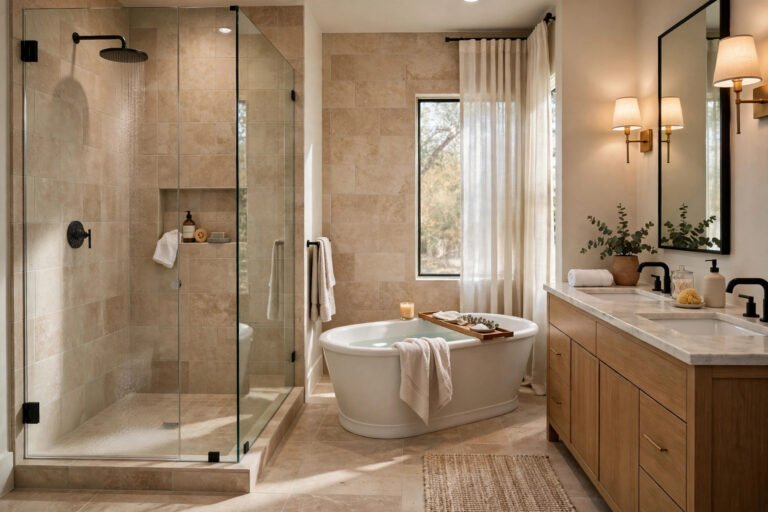
A walk-in shower has a simple, open entry with little or no step. The most luxurious version is a curbless shower, where the bathroom floor flows straight into the shower with no lip or curb to step over. Frameless glass — a panel with almost no visible frame — keeps the view open and makes the room feel larger.
Large-format tile helps too: fewer grout lines mean a calmer, more seamless look. Add a built-in niche, a small recessed shelf in the shower wall, for shampoo and soap.
Rainfall heads, body jets, and steam: what each adds
A rainfall showerhead is a wide, flat head mounted overhead that drops water straight down like gentle rain. A standard showerhead gives a stronger, more focused spray. Many people choose both: a rainfall head plus a handheld sprayer.
Body jets are small spray nozzles set into the shower wall. They add plumbing complexity and cost, so they suit a full remodel rather than a refresh. A steam shower turns the enclosed shower into a warm steam room, but it needs a sealed enclosure, a steam generator, and good ventilation, and it must be installed by a professional. Never seal up a shower for steam without proper ventilation and professional installation, because trapped moisture can damage walls and feed mold.
If your budget allows only one shower upgrade, pick a quality rainfall or multi-function head and a frameless glass panel.
Vanities, Storage, and Clear Surfaces
The vanity is the cabinet and counter that hold your sink. It sets the tone of the room, and it is where clutter collects.
A floating vanity is mounted to the wall with open floor space beneath it. It makes the room feel larger and makes cleaning easier. A double vanity gives two people their own sink and counter space, but only choose one if both people will truly use it — two sinks in a small room can crowd out storage you need more.
Inside the vanity, drawer organizers keep small items from turning into a jumble, and a recessed medicine cabinet — one set into the wall behind the mirror — hides daily products without taking counter space.
Then comes the simplest luxury rule of all: keep the counter nearly clear. Put away everything except one or two beautiful items, like a small tray or a plant. Clear surfaces are free.
For more whole-home ideas, browse the luxury home design collection.
Lighting That Flatters the Room (and You)
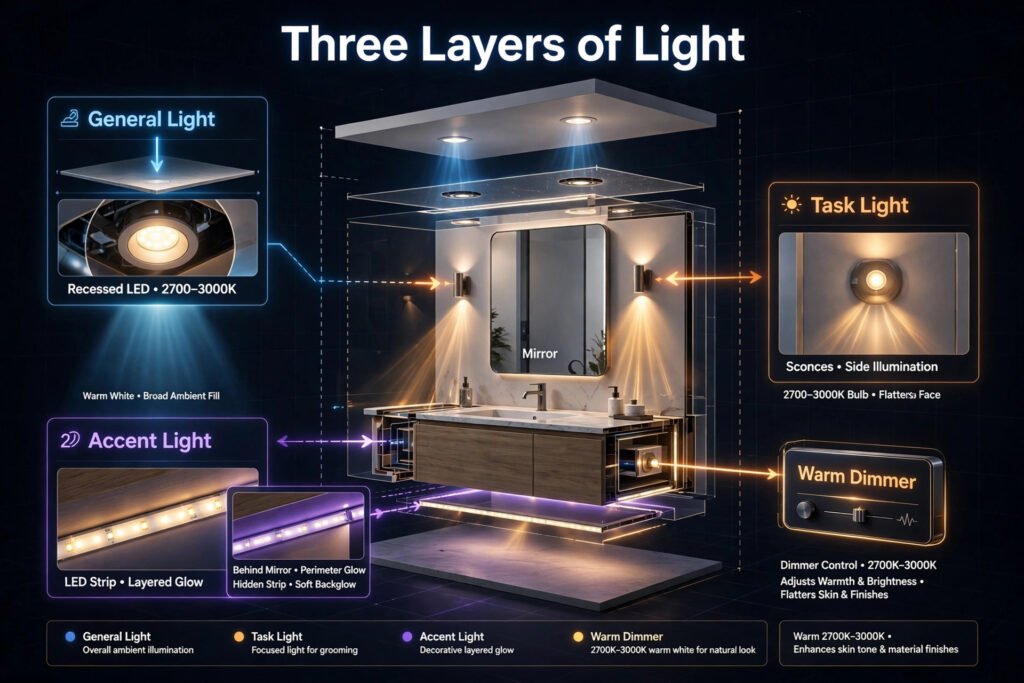
Lighting separates a builder-grade bathroom from a luxury one more than almost any other element. Most bathrooms suffer from a single harsh overhead light that flattens the room and casts shadows on your face at the mirror. Fix it with layers, which simply means using more than one kind of light.
The three layers: general, task, and accent
General light fills the room, usually from recessed ceiling lights. Task light helps you see what you are doing: sconces — small wall lights — on either side of the mirror are the best task light for grooming, because light from both sides removes shadows. Accent light highlights a feature, like LED strips under a floating vanity or behind a mirror.
Add a dimmer to at least the main lights, so the room shifts from bright in the morning to soft and spa-like at night. Choose warm white bulbs in the 2700K to 3000K range. The “K” stands for Kelvin, a scale for light color, and this warm range makes skin tones and wood finishes look richer.
A backlit mirror — a mirror with light built in behind its edge — is one of the best single lighting upgrades. If you can only change one thing, change the lighting first: it makes every other material look more expensive.
For more lighting ideas, see the interior design section.
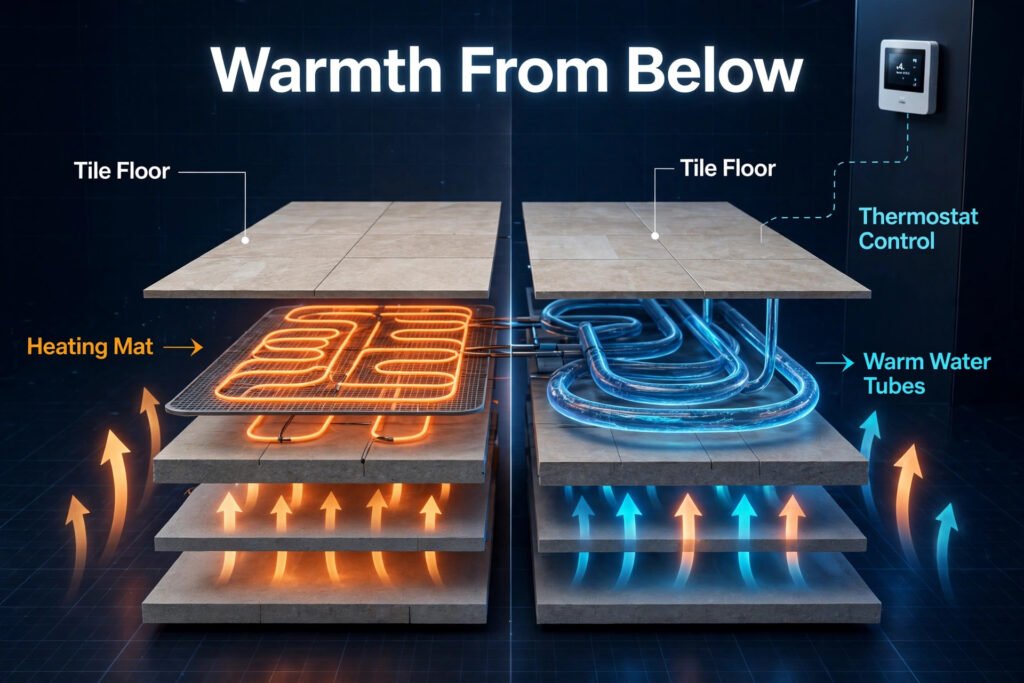
Heated Floors and Smart Comfort Features
Few upgrades feel as luxurious as stepping onto a warm floor on a cold morning. Radiant floor heating, also called underfloor heating, warms the floor itself instead of blowing warm air through vents, so the room feels evenly warm and quiet.
Electric vs. hydronic heated floors
There are two main types. Electric systems use heating cables or mats under the floor, wired to a thermostat. They suit small spaces like bathrooms and are simpler to install during a remodel. Hydronic systems pump heated water through tubes under the floor; they suit larger areas or new construction better, but they need a boiler or water heater and more complex plumbing.
According to Bob Vila’s radiant floor heating guide, professional installation typically runs $1,700 to $6,170, with a national average of $3,831, and bathrooms typically run $2,000 to $6,500. Read Bob Vila’s full breakdown of radiant floor heating cost before you decide. These are installed costs, not product-only prices.
A few cautions before you commit. Heated floors work best when the floor is already being replaced, since the system goes underneath it. The finished floor can sit slightly higher, so plan the transitions into hallways to avoid a tripping edge. Never wire a floor heating system yourself unless you are qualified: have a licensed electrician connect it, and confirm your flooring is rated by its maker for use over radiant heat.
Smart mirrors, touchless faucets, and heated towel rails
Smart features can add real comfort, but choose them for daily use, not novelty. A smart mirror with built-in light and an anti-fog feature is genuinely useful every morning. A touchless faucet saves water and keeps the fixture cleaner. A heated towel rail gives you a warm towel after every shower. Skip features you will not use — a mirror that shows the news is money spent on a screen in a wet room if you never look at it.
Small Luxury Bathrooms: Big Feel in Less Space
Small bathrooms are actually easier to make feel luxurious in one way: there is less area to cover. A stone remnant — a leftover piece from a larger job, often sold at a discount — that would be far too costly for a large room can fit a small vanity top easily. Ask a stone fabricator about remnants before you pay full price for a slab.
Use a few space tricks. A large mirror, or one covering most of a wall, bounces light and doubles the sense of space. A wall-mounted sink or a floating vanity keeps the floor visible, which makes the room feel bigger. Keep the palette to two colors and let texture — towels, wood, stone — do the work.
Renters can join in too. You may not be able to move plumbing or retile, but you can change the mirror, the showerhead, the hardware, the towels, and the lighting. Always check your lease first, and keep the original fixtures so you can restore them later.
For more affordable luxury ideas, see this guide to luxury bathroom ideas on a budget.
What a Luxury Bathroom Costs (and Where to Spend)
Costs vary widely by room size, region, and scope, so treat every figure here as an example, not a quote. A cosmetic refresh — new faucet, hardware, mirror, lighting, paint, and textiles, with no plumbing moves — can land around $1,000 to $3,000. That is the fastest path to a luxury feeling.
A full remodel costs far more. Bob Vila puts a primary bathroom remodel at $15,000 to $55,000, and a high-end bathroom at $20,000 to $100,000, with labor often making up 40 to 65 percent of the total. See the full bathroom remodel cost guide for the breakdown. Get a detailed, written, line-item quote from your own contractor before you commit.
Choose a refresh when the layout works, the tile is sound, and there is no water damage. Choose a full remodel when the layout does not function, tile is failing, moisture problems keep returning, or you want features that cannot be added cheaply, like heated floors.
Splurge here, save there
Splurge on what you touch and see daily: the faucet, the shower fixtures, the lighting, and the towels. Save on tile, where a well-laid affordable porcelain beats a poorly installed expensive stone. Save on the vanity cabinet, since a stock cabinet with quality hardware and a good faucet reads as custom. Save on countertops by asking about stone remnants.
For broader planning ideas, see the home design collection.
Mistakes That Make a Bathroom Look Cheap
Avoid these five errors. First, mismatched metal finishes. Second, harsh overhead lighting with no dimmer and no sconces. Third, cluttered counters: if every product you own sits on the counter, no fixture upgrade can save the look. Fourth, too many colors or patterns competing at once. Fifth, poor-quality fake materials — an obvious imitation stone looks worse than an honest, simple material chosen well.
One more mistake is quieter but costly: skipping ventilation. A good exhaust fan protects paint, grout, wood, and stone from moisture damage.
A Simple Plan to Start This Weekend
You do not need to do everything at once. Start here:
- Clear the room completely: remove everything from counters, shelves, and the tub edge.
- Clean the grout, fixtures, and glass.
- Swap the bulbs for warm white (2700K to 3000K) and add a dimmer — or have an electrician do it.
- Replace the mirror with a framed or backlit one, and match the cabinet hardware to your faucet finish.
- Add thick towels in one color, a tray for the few items that stay out, and one plant.
That is a weekend, not a remodel. If you love the result, plan the next step from a position of calm rather than frustration.
Frequently Asked Questions
What is a luxury bathroom?
A luxury bathroom is a calm, well-planned room built around quality materials, good lighting, a strong focal point like a freestanding tub or a walk-in shower, and clear surfaces.
Can a small bathroom feel luxurious?
Yes. Small rooms need less material, so you can afford better finishes, a stone remnant for the vanity top, and a large mirror. Keep the palette to two colors, use a floating vanity to show more floor, and keep counters clear.
Is a freestanding tub worth it?
It is worth it if you take baths often and your room has space around the tub so it looks sculpted, not squeezed in. It is not worth it if you shower daily and rarely bathe. Check floor support and drain position before you buy.
How much does a luxury bathroom remodel cost?
It depends on scope and location. A cosmetic refresh can run about $1,000 to $3,000. A primary bathroom remodel is often $15,000 to $55,000, and a high-end bathroom can reach $20,000 to $100,000, according to Bob Vila. Always get a written, line-item quote for your own room.
What is the cheapest way to make a bathroom look luxurious?
Start with light, finishes, and clutter — the three cheapest luxury signals. Swap in warm bulbs and a dimmer, match all metal finishes, replace thin or mismatched towels with thick ones in one color, and clear the counters. Then add one focal point, like a framed mirror or a quality faucet.
A Calm Room, Built One Choice at a Time
A luxury bathroom is not a shopping list. It is a series of calm decisions: one palette, one metal finish, one focal point, light that flatters you, and surfaces with room to breathe. Pick the decision that bothers you most today — usually the lighting or the clutter — and fix that first.
When you are ready to look beyond the bathroom, the Luxury Homes Idea homepage is a good place to explore. Start small, choose well, and enjoy the room every single day.