Luxury Kitchen Design: How to Plan a Beautiful Kitchen That Works Every Day
A luxury kitchen design is not just an expensive kitchen. It is a kitchen planned around how you cook, gather, and live, with strong materials, smart storage, and lighting that makes daily work easy. A room can feel luxurious at many budgets when the layout fits, the surfaces suit real cooking, and the details are finished with care.
Luxury does not mean buying the most costly option in every category. Choose fewer, better pieces, and spend where you will feel the difference every day. If a feature looks good in a photo but makes cooking harder, it is not a luxury for your home.
What Makes a Kitchen Feel Luxurious
Luxury starts with fit and finish. Fit means cabinets close cleanly and drawers open fully. Finish means edges are smooth, joints are neat, and materials look good up close, not only from across the room.
Three qualities show up again and again in high-end kitchens: calm, because counters stay clear; texture, because wood, stone, metal, and glass mix warmly; and ease, because doors close softly and light falls where you need it.
Try a simple test. Stand where you cook most often. Can you reach your pans, knives, and spices without walking across the room? Can you set down a hot tray safely? If the answer is yes, the kitchen already has the heart of luxury design. Pick one or two focal points, such as a dramatic island or a bold stone slab, then keep the rest of the room quieter.
Choose a Layout That Fits How You Cook
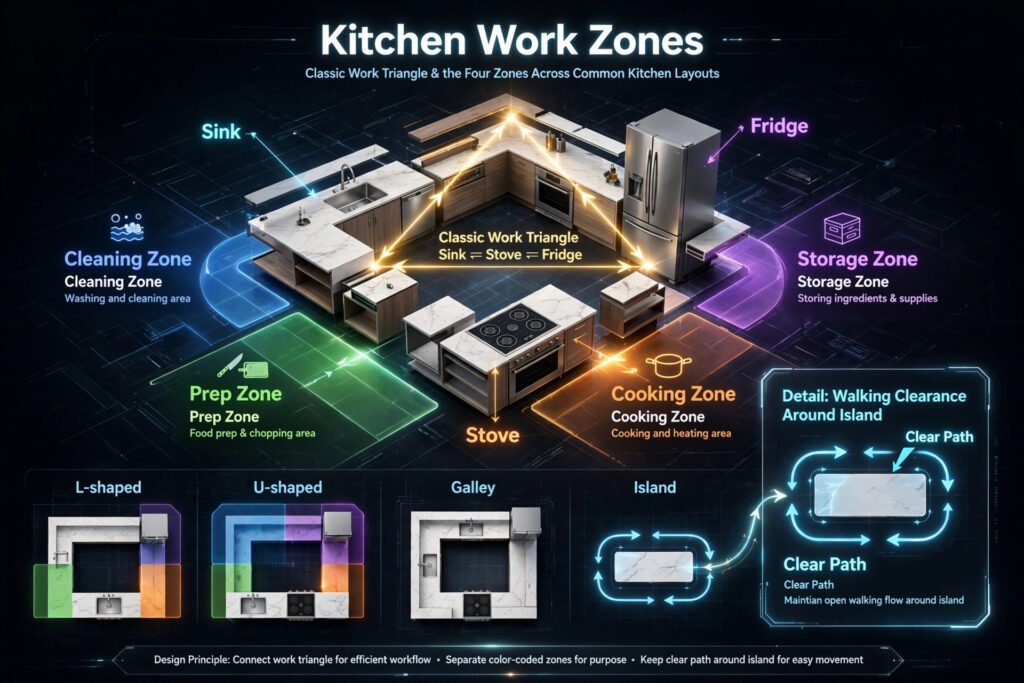
Start with layout before you pick colors or appliances. The layout decides how far you walk, where guests stand, and how much counter space you have. The classic work triangle links the sink, the stove, and the refrigerator. When they sit close enough to reach in a few steps, but not so close that you feel crowded, cooking feels smooth. In open kitchens, many designers now think in zones instead: prep, cooking, cleaning, and storage. Zones work well when more than one person cooks.
Here are the layouts most homes use:
- L-shaped: Two walls meet in a corner, leaving room open for dining or seating.
- U-shaped: Cabinets run along three walls, giving the most counter and storage space, but it can feel closed in a small room.
- Galley: Two parallel runs face each other. Efficient for one cook in a narrow room.
- Island: Adds prep space, storage, and seating, and works best when you can walk around it with ease.
Check an island in real life, not only on a plan. You need room to open the dishwasher, pull out a drawer, and pass another person without turning sideways. Keep guest seating a little away from the stove and the main prep path, so conversation does not block cooking. For ideas on how a kitchen should connect with the rest of your home, see our home design ideas.
Cabinets and Storage That Stay Calm and Useful
Cabinets often take the largest share of a kitchen budget. They cover the most wall space, hold almost everything, and you touch them many times a day. In a luxury kitchen, cabinets are usually built to fit the room. Custom cabinets are made for your exact measurements. Semi-custom cabinets offer more sizes than stock cabinets, but still follow set sizes. Stock cabinets cost less, but may leave gaps. An odd corner or tall ceiling may justify custom work; a simple rectangular room may look just as good with semi-custom cabinets.
Look past the door style and check how the inside works:
- Deep drawers for pots and trays, so you lift less.
- Pull-out shelves in lower cabinets, so items at the back come to you.
- A tall pantry pull-out, with sections for daily and backup supplies.
- Dividers for trays, boards, and lids.
- A trash and recycling drawer close to the prep area.
- Soft-close hinges and slides, which stop slamming.
Handleless cabinets, where doors open with a push or a recessed grip, give a clean, modern look. They do show fingerprints more on some finishes, so ask for a sample before you commit. In a busy family kitchen, a slim handle may be easier to grab with wet hands. Floor-to-ceiling cabinets add storage for items you use less often; keep daily items at waist to shoulder height.
Countertops, Backsplash, and Surfaces: Pick for Real Life
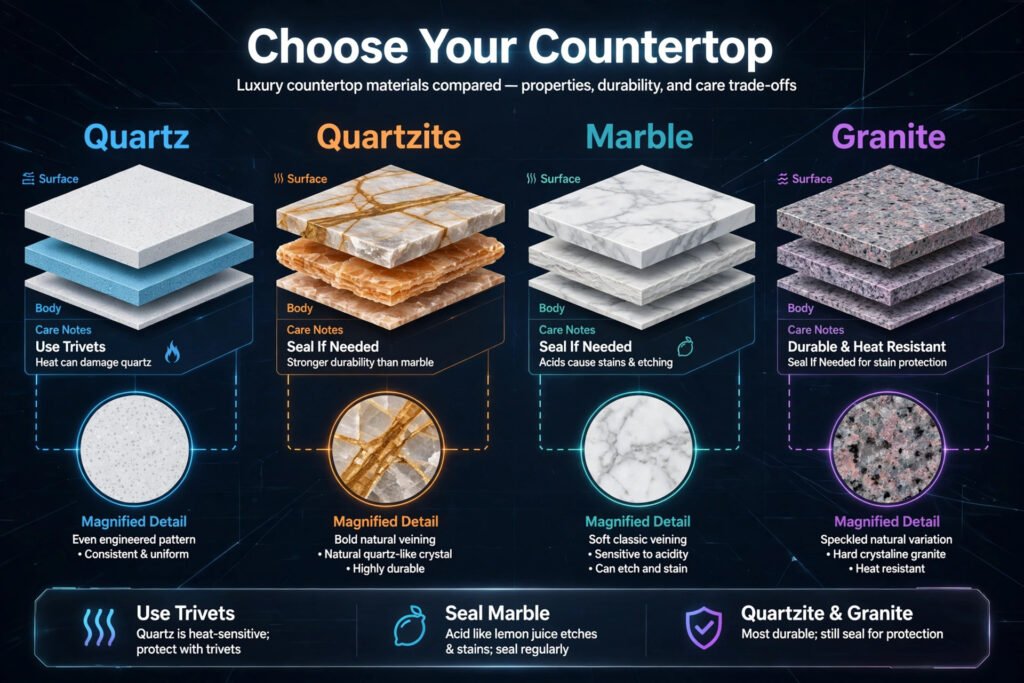
Countertops take daily abuse from hot pans, knife work, spills, and stains. The best luxury surface is one you enjoy using, not one you worry about all the time.
| Material | What it feels like | What to watch for |
|---|---|---|
| Quartz | An engineered stone made from crushed quartz and resin. Even color and pattern, and low maintenance. | Heat can damage it, so always use trivets for hot pans. |
| Quartzite | A natural stone with bold veining, often similar in look to marble. Hard and heat tolerant. | Sealing needs vary by stone, so ask your supplier what care your slab needs. |
| Marble | A natural stone with soft, classic veining. It stays cool, which bakers love. | It can stain and etch, which means acids like lemon juice can leave dull marks. |
| Granite | A natural stone with speckled or flowing patterns. Strong and heat tolerant. | Patterns vary a lot from slab to slab, so view your exact slab before you buy. |
Marble is a good test of honest luxury. Some homeowners love the way it ages and see small marks as character. Others see the same marks as damage. Decide before you pay: if marks would bother you daily, quartzite or quartz may suit you better. Marble etches from lemon juice and wine, while quartzite gives a similar look with less worry.
A waterfall edge is when the countertop material runs down the side of the island to the floor. It makes the island look like a solid block of stone, but it uses more stone and costs more. A full-height stone backsplash, where the same stone runs from the counter up the wall, looks seamless and is easy to wipe, but it also adds cost.
Handmade tile adds backsplash texture because no two tiles are exactly alike, while large porcelain slabs reduce grout lines where grease collects. Wide-plank wood adds warmth to floors, large porcelain tile is hard-wearing, and natural stone tile may need sealing. Before you order stone, visit the stone yard if you can, and ask which slab is yours and where the seams will fall.
Appliances and Smart Features Worth the Money
Appliances are where luxury kitchens often feel most different from standard kitchens. The key question is not which brand is most famous. It is which features you will use at least weekly.
A professional-style range usually means a wider range with strong burners, a large oven, and heavy, durable parts. It suits a household that cooks most nights. A household that mostly reheats meals may get the same value from a smaller, high-quality range. Panel-ready appliances are covered with panels that match your cabinets, so the refrigerator or dishwasher blends in. This costs more in some cases: once for the appliance, and again for the panels and fitting. Ask for that combined price first.
Useful luxury features include:
- A wall oven at a comfortable height, so you do not bend deep to lift a heavy dish.
- An induction cooktop, which uses magnetic energy to heat the pan itself. It heats fast and responds quickly.
- A warming drawer for keeping dishes warm.
- A built-in coffee system, if coffee is a daily ritual.
- A wine refrigerator, if you entertain often.
- A quiet dishwasher near the sink, with a matching panel.
Smart features can help, but only when they stay simple. A touchless faucet keeps hands clean while cooking, and app controls can preheat an oven from another room. Choose smart features that still work by hand if the app fails. Ventilation matters as much as the range itself. A range hood pulls steam, smoke, and smells out of the room. For safety, a powerful hood must be sized and vented correctly, and very strong hoods may need makeup air, which is fresh air brought in to replace the air the hood removes. Ask a licensed professional to check ventilation, gas, and electrical needs before you buy a professional range.
Layered Lighting That Makes Materials Look Their Best
Lighting is one of the highest-value upgrades in a luxury kitchen. It is often less costly than stone or cabinetry, but it changes how every other material looks. One ceiling light is not enough.
Think in three layers: task lighting, such as under-cabinet lights over counters; ambient lighting, such as recessed ceiling lights on a dimmer; and accent lighting, such as lights inside glass cabinets.
Put each layer on its own control or dimmer when you can, so the kitchen can be bright for chopping at noon and soft for dinner at night. Warm light suits wood and stone better than harsh, bluish light. Check the light color on your actual materials before final fitting.
Statement pendants over an island can act as jewelry for the room. Keep them high enough that they light the counter without blocking sightlines. If your kitchen has a window over the sink or a door to the garden, keep that view clear. For more on connecting indoor and outdoor living, explore our outdoor and garden ideas.
Color, Texture, and Style Without a Cold Showroom Feel
Many recent luxury kitchens move away from stark, all-white rooms toward warmer tones. Cream, soft beige, taupe, muted green, and natural wood add depth without losing a clean look. Build a palette from three elements: a main cabinet color, a countertop stone, and one accent, such as the island color or a metal finish. Keep the rest calm. For example, warm wood cabinets, a light quartzite counter, and brushed brass handles give a clear, warm story.
Mix textures on purpose. A smooth stone counter, a fluted wood panel, and a matte cabinet front each add a different feel. Fluted wood means wood with narrow, vertical grooves that catch light and shadow. Ask for samples and live with them for a few days before you order.
Choose a style that fits your home:
- Modern: Clean lines, flat fronts, and hidden handles.
- Traditional: Raised panels, crown molding (trim where cabinets meet the ceiling), and warm colors.
- Transitional: A mix of modern and traditional, with simple fronts and soft colors.
- Farmhouse luxury: Warm wood, an apron-front sink (a farmhouse sink with a front panel on the cabinet face), and modern hardware.
If your kitchen opens to living areas, carry one or two materials through both spaces. See our interior design ideas for ways to keep that link calm.
Plan Your Budget and Timeline Without Surprises
Luxury kitchen costs vary widely, so a single price tag can mislead. Size, layout changes, cabinet tier, stone choice, and appliance package move the total most. Published guides give a planning range, not a quote for your home.
Bob Vila’s kitchen remodel cost guide puts a typical remodel at $14,589 to $41,538, with a national average of $26,974. By scope, it lists a small remodel at $10,000 to $20,000, a mid-scale remodel at $20,000 to $65,000, and a large-scale remodel at $65,000 to $130,000, with labor at about 25 percent and costs of $75 to $250 per square foot. These are estimates, not prices for your project.
Where does the money go? In most guides, cabinets are the largest share, often around 30 percent of the total, followed by appliances, countertops, and labor. Bob Vila puts labor at about 25 percent of the total. Separate product prices from installation costs in every quote. A stone slab price is not the same as the installed price with cutting, edge work, and fitting.
Keep a contingency fund for surprises found once walls open. Many guides suggest 10 to 15 percent of the budget. Order appliances early, and agree in writing on scope, materials, timeline, and how changes will be priced. Compare at least two or three bids based on the same scope. If you need a timeline, ask your contractor.
Before you hire, check licenses and insurance, and ask for recent references. For gas, electrical, plumbing, or removing a wall, use licensed professionals and get the permits your local rules require. Never remove a wall on a guess about whether it is load-bearing, which means it helps hold up the structure above it.
How to Get the Look in a Smaller Kitchen or Without a Full Remodel
A small kitchen can feel luxurious without growing larger. Clear counters, good light, strong materials, and storage that fits your habits matter more than square footage.
Try these focused upgrades first: replace dated hardware; add under-cabinet lighting; add pull-outs or dividers inside existing cabinets; use a light, warm palette with one wood or stone accent; and keep open shelving to one short run. Open shelves collect grease and dust, so closed storage suits daily items better. Renters can swap hardware and store the originals, add battery or plug-in under-cabinet lights where allowed, and use a freestanding cart for prep space. Check your lease before you change anything fixed. Replacing only counters, lighting, and hardware while keeping sound cabinets can also refresh a room at lower cost, though it will not fix a poor layout.
Common Mistakes to Avoid
Most luxury kitchen regrets come from rushing one decision. Watch for these traps: buying appliances before the layout is set; choosing stone from a photo alone; skipping ventilation planning; adding too many focal points; forgetting daily storage; treating lighting as an afterthought; and planning with no contingency fund.
Walk through your plan with a simple daily test: a weekday morning, a full cooking session, and a dinner with guests. Where do you stand, what do you reach for, and where does clutter collect? Fix those moments first.
Frequently Asked Questions
What is luxury kitchen design?
Luxury kitchen design means planning around daily use, with well-fitted cabinets, durable surfaces, good lighting, and appliances that match how you cook. It is defined more by fit and function than by size or cost alone.
How much does a luxury kitchen remodel cost?
Costs vary by size, scope, and location. Bob Vila lists a large-scale remodel at $65,000 to $130,000, with a typical remodel at $14,589 to $41,538 and a national average of $26,974. Get itemized local quotes, and separate product prices from installation costs before you compare bids.
What is the best countertop for a luxury kitchen?
There is no single best choice. Quartz is low maintenance. Quartzite offers bold veining with strong durability. Marble looks classic but can stain and etch. Granite is strong with wide variation. Pick the surface whose care needs match how you cook.
Can a small kitchen be luxurious?
Yes. Clear counters, layered lighting, well-planned storage, warm materials, and one strong focal point can make a small kitchen feel luxurious. Fit, light, and material quality matter more than square footage.
Do I need smart technology in a luxury kitchen?
No. Smart features can add ease, such as touchless faucets, but they are not required. The best luxury technology is reliable, usable by hand if needed, and chosen for a real daily task.
A Practical Way to Start
Start with how you live, not with a shopping list. Note your top three daily frustrations in your current kitchen, and your top three moments you enjoy, such as morning coffee or hosting friends. Use those notes to set your layout, storage, and focal points. Then get itemized quotes, view your stone in person, and plan lighting before wiring is fixed. When the layout fits and the materials suit real cooking, the room will stay luxurious for years. For more whole-home ideas, explore luxury home design on Luxuryhomesidea.