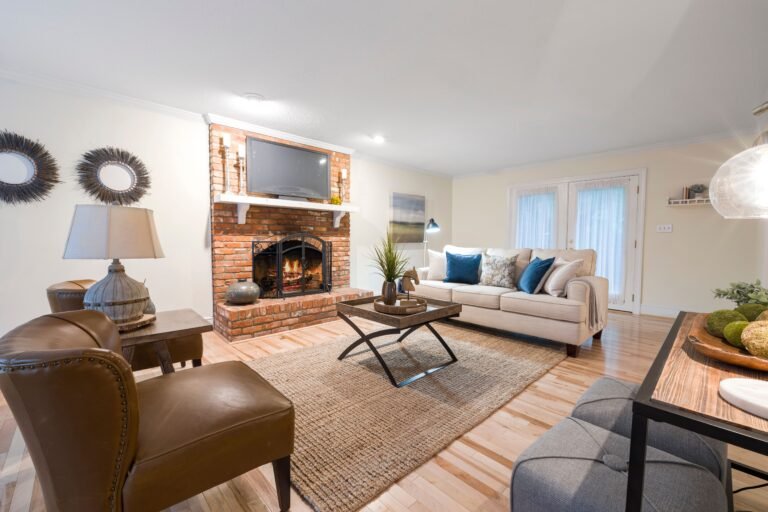
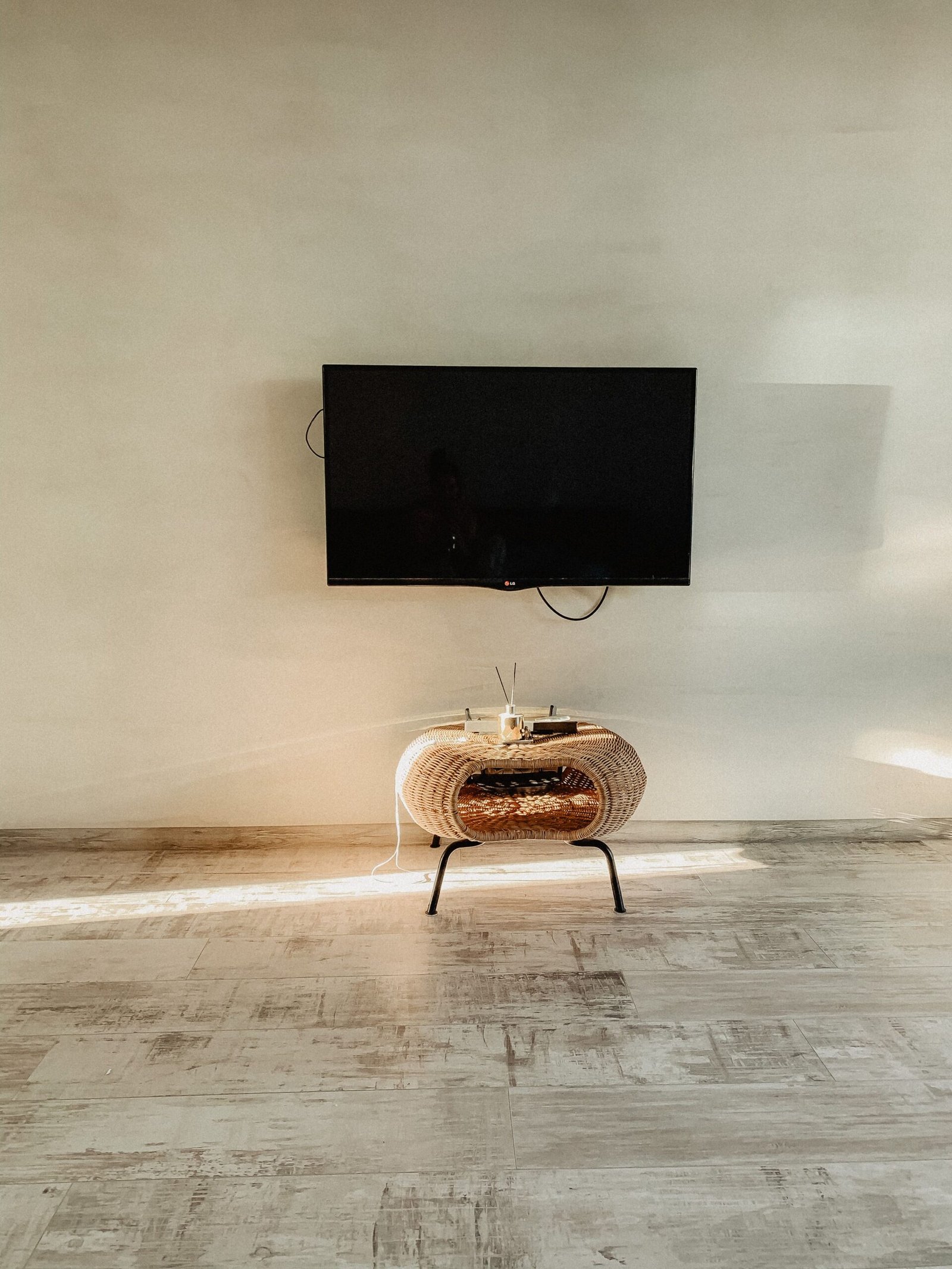
TV Wall Ideas That Make the Screen Feel Like Part of the Room
A good TV wall is a wall where the screen sits at a comfortable height, the cables have a plan, and one clear design treatment ties the wall together. That is the whole test. If you can watch for an hour without neck strain, and the wall still looks calm when the TV is off, the design works.
Style comes after those two checks. A wood panel or a gallery wall cannot fix a screen that is too high, and a large TV cannot fix a tangle of cables. So this guide starts with placement, then moves to ideas, mounts, fireplaces, cables, and small or rented rooms. It ends with a worked example for one ordinary living room.
Start With the Wall, Not the Panel
Pick the wall before you buy panels, shelves, or a console. Sit in your usual seat and look at each option. Ask four questions:
- Can you see the screen without turning your head?
- Does light from a window or lamp hit the screen at the time you usually watch?
- Is there a power outlet nearby, or a sensible path for cables?
- Does the wall leave a clear walkway, so no one brushes past the screen?
The wall that passes all four is usually the right one, even if it is not the wall you first imagined. A wall opposite a large west-facing window, for example, can look fine at noon and glare badly at sunset. Check it at your real viewing time.
Also think about what else the wall must do. If it holds the room’s only storage, a console wall may beat a bare panel wall. If the room is also for conversation, the TV should share the wall calmly with seating, not dominate it. For more room inspiration, browse the interior design ideas on Luxury Homes Idea.
Get Height and Distance Right First
This is the step most people skip, and it is the one you will feel every evening.
Sit where you normally watch, look straight ahead, and mark that eye level on the wall. The centre of the screen should land close to that mark. This Old House’s TV mounting guide gives the same rule: the screen should be at eye level when you’re seated, and a tilting mount reduces glare from windows or lights.
In many living rooms, that puts the screen centre roughly 42 to 48 inches from the floor, but that range is only a starting point. A low sofa, a recliner, or a tall viewer changes it. Trust your own eye level over any number.
Distance matters too. Sony suggests watching at 2 to 5 times the screen’s diagonal size, with the exact spot depending on the TV. A 65-inch TV, for example, sits in a different range than a 43-inch TV, so measure your diagonal and your sofa distance before you choose a size. If you already own the TV, move the seating first if you can. It is easier than moving a mounted screen.
Try the tape test before you drill. Cut painter’s tape to the TV’s width and height, stick the outline on the wall at your planned height, and sit down. Watch the outline for a few minutes. Does your neck stay relaxed? Can everyone in the main seats see it? Move the tape, not the TV.
Six TV Wall Ideas, and Who Each One Suits
Painted Accent Wall
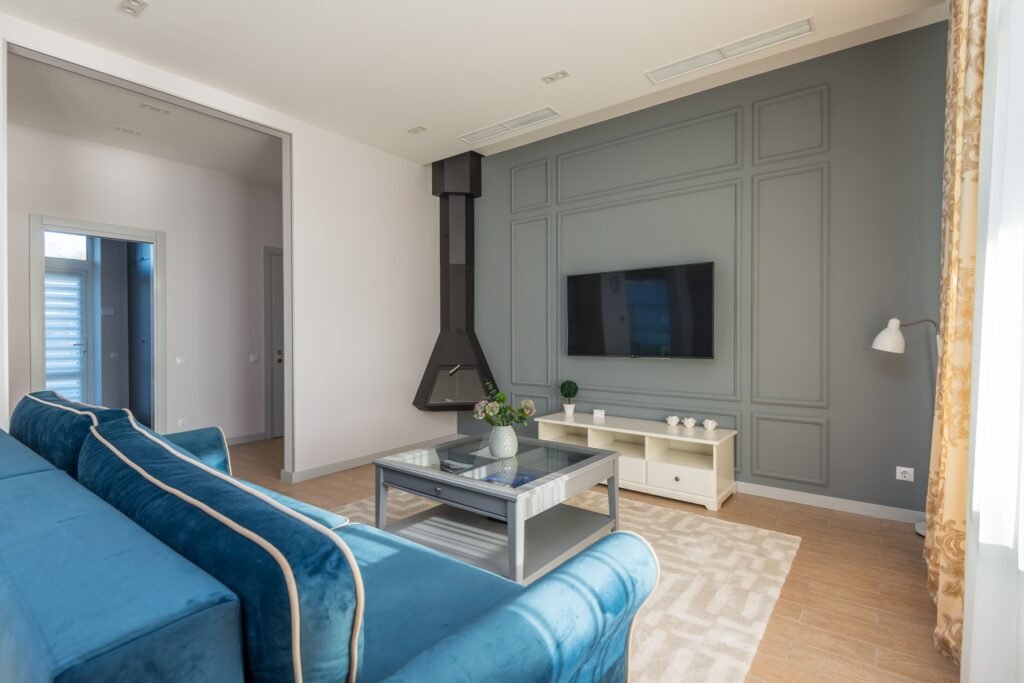
Paint the TV wall one calm, deeper tone than the other walls. Darker colours reduce the contrast between a switched-off black screen and the wall, so the TV blends in. This suits renters and tight budgets because paint is easy to change. Keep the other walls lighter so the room does not feel smaller.
Wood Slat or Panel Wall
Vertical wood slats or flat panels add texture and hide small cable channels behind them. This suits rooms that feel flat or echoey, and rooms where you want warmth without a full built-in. Leave even gaps between slats, and stop the panel at a clean edge, such as a corner or a door frame, so it looks finished rather than patched on.
Low Console Plus Open Shelves
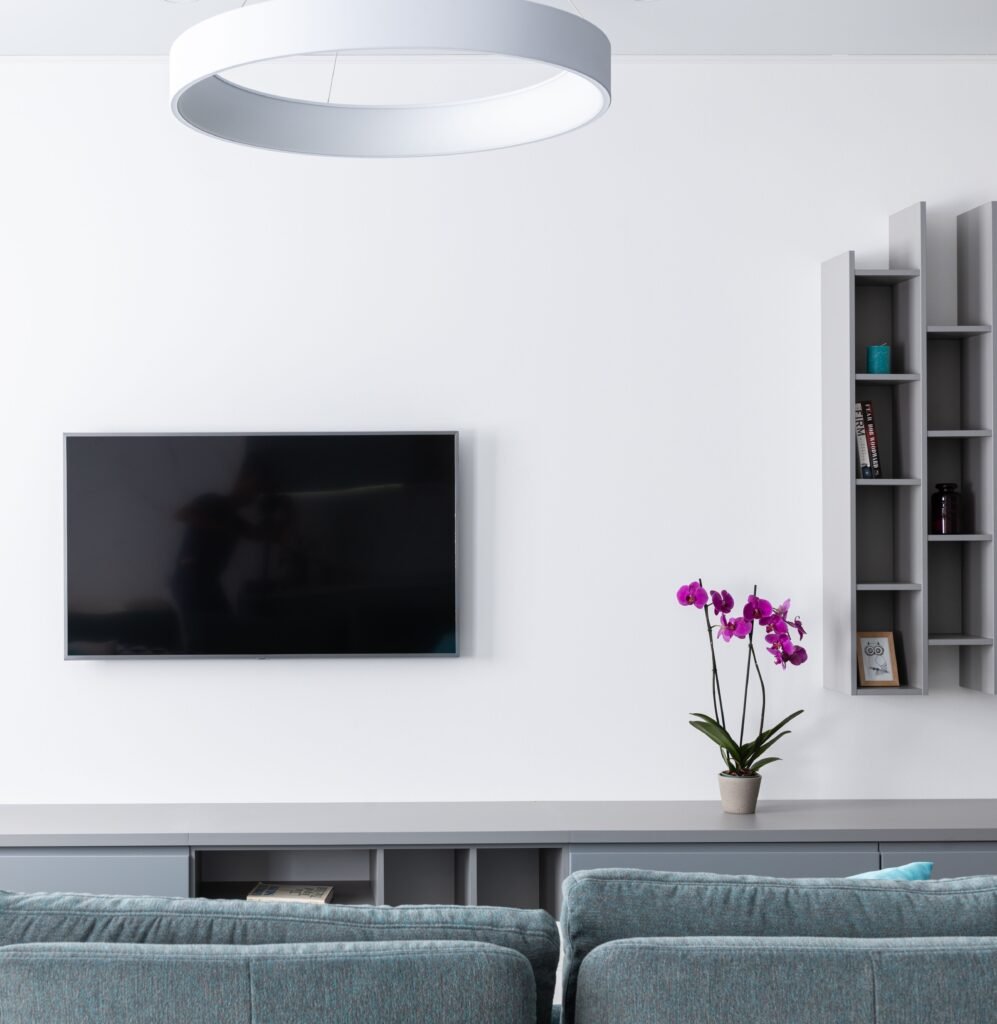
A low, wide console under the TV holds boxes and games, while one or two open shelves hold a few books or plants. This suits families who need storage but do not want a tall unit. Keep the shelves sparse. When every shelf is full, the wall competes with the screen.
Full Built-In Wall
Built-ins frame the TV with closed storage on both sides and sometimes above. This suits a main living room where clutter is the real problem. Plan door fronts that let remote signals through, or keep the streaming box in an open spot. A built-in should be measured to the room, not copied from a photo of a larger space.
Gallery Wall Around the Screen
Hang art around the TV in a simple grid or a loose arrangement. This suits people who love art and want the screen to feel like one object among many. Use frames in one or two finishes, keep spacing even, and hang nothing that reflects light straight onto the screen.
Hidden TV Wall
A sliding panel, cabinet doors, or a frame-style screen cover hides the TV when it is off. This suits rooms used mainly for conversation or reading, where a black rectangle feels wrong. Test the mechanism before you commit. A cover that is hard to open will simply stay open.
Choose a Mount With This Comparison
A mount is not just hardware. It decides how much you can adjust later. Check three things on your TV first: its weight, its screen size, and its VESA pattern. VESA is the standard spacing of the mounting holes on the back of the TV. Your mount must match your TV’s pattern and weight limit, and you must follow the mount maker’s instructions.
| Mount type | What it does | Suits | Watch out for |
|---|---|---|---|
| Fixed | Holds the TV flat against the wall | Eye-level walls, tidy look | No angle adjustment |
| Tilt | Angles the screen down a little | TV mounted slightly high | Small range of movement |
| Full-motion | Pulls out and turns sideways | Corners, open plans, glare | Needs a strong wall fixing |
| Pull-down | Lowers a high TV for viewing | Above a fireplace or tall console | Heavier, pricier, needs care with cables |
For most eye-level walls, a fixed or tilt mount is enough. Choose full-motion only if you truly need the movement, because every moving part adds weight and complexity. Whatever you choose, fix it into wall studs — the vertical wooden or metal supports inside the wall — or use fixings rated for your wall type. A TV must never hang from plasterboard alone unless the fixing is specifically rated for that load. If you are unsure about your wall, ask a professional installer before drilling.
TV Above a Fireplace: When It Works and When It Does Not
A TV above a fireplace can work, but it often fails on height. A tall mantel pushes the screen above comfortable eye level, and heat can damage the TV. Before you commit, check both manuals: the fireplace maker’s clearance rules and the TV maker’s heat limits. Clearances vary by fireplace type, so one rule does not cover gas, electric, and wood-burning units alike.
Bob Vila’s TV above a fireplace guide explains that the risk depends on the fireplace type, and gives a thermometer test — if the wall reaches 100°F, the spot is too hot for a TV.
Practical checks that help:
- Run the fireplace for 45 to 60 minutes and feel the planned TV spot. If it feels hot to your hand, do not mount there.
- Leave ventilation space around the screen, as the TV manual directs.
- Use a mantel shelf or heat shield only if the fireplace maker allows it.
- Consider a pull-down mount, or place the TV beside the fireplace instead.
The beside-the-fireplace option is often the better room. It keeps the screen at eye level, leaves the fireplace as its own feature, and gives you a wall for storage or art. A TV does not have to be the highest thing in the room to be the main screen.
Hide Cables Without Creating a Safety Problem
Cables ruin more TV walls than bad paint does. Plan them before the mount goes up, not after.
The simplest safe options are surface raceways — slim covers that stick to the wall and hide cables — and a hollow panel or console that routes cables behind it. Both keep cables out of sight without opening the wall. Match the raceway colour to the wall, and run it in a straight vertical line to the console. A diagonal cable channel draws the eye.
Running cables inside the wall is a different job. Before you cut into a wall or route mains power cables inside it, hire a licensed electrician. In-wall electrical work can breach local codes, damage hidden wires or pipes, and create a fire risk if done wrong. This boundary matters more than a tidy look. A licensed electrician can tell you what is allowed in your home and whether a new outlet behind the TV is the safer fix. Never run a standard power cord inside a wall as a shortcut.
Also plan for the boxes. A streaming box, game console, and router each need power, air, and a remote signal path. Put them in a ventilated console, leave space around them, and keep the remote sensor clear. Overheating boxes fail early and often.
Small Rooms and Rentals
Small rooms need a lighter touch. A slim panel or a painted wall beats a deep built-in, because depth eats floor space. A low console keeps sightlines open, and a single shelf above or beside the TV can hold a plant without crowding the screen. Leave some empty wall. Empty space is what makes a small TV wall feel calm rather than cramped.
Renters can still get a finished look. Paint, if your lease allows it, is the biggest change for the lowest damage. A leaning console, a freestanding panel, or a slim media unit gives the TV a home without drilling. If you do mount, use a French cleat or a mount fixed to studs, keep the fixings minimal, and photograph the wall before you start so you can repair it later. Always check your lease first.
For renters, the tape test matters even more. You cannot easily move a mounted TV, so test the height, the glare, and the seating view with tape and a borrowed second pair of eyes before any holes appear.
A Worked Example: One 12 × 15 ft Living Room, Three Decisions
Imagine a 12 by 15 foot living room. The sofa sits on the long wall, facing a blank wall 11 feet away. A window sits on the left wall, so afternoon light crosses the room but does not hit the blank wall directly. The household watches most evenings, rents the home, and owns a 55-inch TV.
Decision one is the wall. The blank wall wins because it faces the sofa directly, avoids window glare, and has an outlet near one end. The window wall loses because glare would hit the screen each afternoon.
Decision two is height. The seated eye level in this example is about 42 inches from the floor, so the screen centre is planned at 42 inches. The tape outline confirms that the whole household can see it without tilting their heads.
Decision three is the treatment. Because the household rents, a full built-in is out. They choose a painted accent wall in a warm mid-grey, a low console for boxes, and a slim surface raceway painted to match the wall. The result is tidy, low-damage, and comfortable, without a single structural change. The lesson is simple: the three decisions — wall, height, treatment — in that order, beat any single decor purchase.
Mistakes That Make a TV Wall Look Unfinished
- Mounting first and measuring later. Tape first, drill second.
- Centring the TV on the wall instead of on the seating. Centre it on the viewers.
- Filling every shelf. Leave breathing room around the screen.
- Running cables diagonally or leaving them loose behind the console.
- Ignoring glare. Check the wall at your usual viewing time, not just at noon.
- Choosing a TV that is too large for the distance. A bigger screen is not better if you sit close enough to see pixels and strain your eyes.
Frequently Asked Questions
How high should I mount my TV?
Mount it so the centre of the screen is close to your seated eye level. In many rooms that is roughly 42 to 48 inches from the floor, but your sofa height and your own eye level matter more than the range. Use painter’s tape to test before drilling.
Can I put a TV above a fireplace?
You can, but only if the height stays comfortable and the heat stays within the TV and fireplace makers’ limits. Test the heat at the planned spot, check both manuals, and consider placing the TV beside the fireplace instead if the mantel is tall.
How do I hide TV cables safely?
Use a surface raceway or route cables behind a panel or console. Do not run standard power cords inside a wall. For in-wall power or a new outlet, hire a licensed electrician first.
What is a good TV wall idea for a rental?
Paint (if allowed), a low console, and a freestanding or slim panel wall. If you mount, fix into studs, keep holes minimal, and check your lease. The tape test protects you from a costly mistake.
Do I need a full-motion mount?
Only if you need to turn or pull out the screen for different seats or to beat glare. For a straight-on, eye-level wall, a fixed or tilt mount is simpler and tidier.
A Simple Way to Finish
Choose the wall that faces your seats and avoids glare. Set the height by your own eye level, and test it with tape. Pick one wall treatment that suits your room and your lease. Then hide the cables safely, and check the fireplace rules if one is involved. Done in that order, a TV wall stops being a black rectangle on a blank wall and starts feeling like part of the room.
If you want to explore how the rest of the room can support that wall, the about Luxury Homes Idea page explains the site’s approach: comfort, proportion, and practical choices over decoration alone.
Disclaimer
This article gives general home design information only, and homes, walls and viewing needs vary. For in-wall electrical work, fireplace clearances or wall strength concerns, hire a licensed professional before you start.