Luxury Kitchen Cabinets: A Beginner’s Guide to Styles, Materials, and Costs
Luxury kitchen cabinets fit your kitchen’s exact size. They have strong boxes, well-made doors, good hardware, and a careful finish. The word luxury describes that build. A pretty door on a weak box is not luxury, even if it costs a lot.
Prices vary widely. Region, kitchen size, materials, and quote inclusions all change the total. Every dollar figure here is a labelled estimate. It is not a quote for your home.
What Makes a Cabinet “Luxury”?
Start with the parts, not the label. A cabinet has a box, doors, drawer boxes, shelves, and hardware. Hardware means hinges, slides, handles, and pulls.
The box is the main structure. It holds your dishes and pots for many years. A strong box is usually plywood. Plywood is thin wood layers glued with grain in different directions. That build makes it strong and stable. A weak box may use particleboard. Particleboard is wood particles pressed into a flat panel. It works in a dry, low-use spot. It swells and weakens when it stays wet.
Finish is the paint, stain, or lacquer on the surface. Lacquer is a hard, smooth coating sprayed in thin layers. A good finish looks even and resists chips at corners. Soft-close hinges let doors close gently, not slam. Full-extension slides let a drawer pull all the way out. You can then reach the back without digging. Dovetail joints are interlocking notches at drawer corners. Dovetail boxes made from solid wood last far longer than stapled thin boxes.
Stock, Semi-Custom, or Custom: Which Tier Fits You?
Stock cabinets are pre-made in standard sizes, often in 3-inch steps. They cost least and arrive fastest.
Semi-custom cabinets are built to order from a maker’s size and finish range. You can change many sizes in small steps. You get far more colors and door styles. The box is often plywood. Drawers are often dovetail hardwood.
Custom cabinets are built from scratch for your exact kitchen. You can choose almost any size, wood, door shape, and finish.
The table below uses Bob Vila’s installed per-linear-foot estimates — see this stock vs. custom cabinet comparison for the full tier breakdown. Lead times and lifespans vary by build and care, so treat them as planning estimates. Installed means materials plus labor.
| Tier | Installed cost per linear foot (estimate) | Lead time (estimate) | Expected life (estimate) |
|---|---|---|---|
| Stock | $100 to $300 | Varies by build and care | Varies by build and care |
| Semi-custom | $150 to $650 | Varies by build and care | Varies by build and care |
| Custom | $500 to $1,200 | Varies by build and care | Varies by build and care |
A linear foot measures cabinet runs. If your cabinets run 20 feet in total, multiply the per-foot figure by 20. That gives a rough starting point. Which tier fits you? Stock fits a rental, a quick refresh, or a tight budget with a standard layout. Semi-custom fits most family kitchens where you plan to stay for years. Custom fits an unusual layout, a rare wood, or a long-term home. For a broader whole-home view, see the luxury home design ideas on this site.
Framed, Frameless, or Inset: How Your Cabinets Are Built
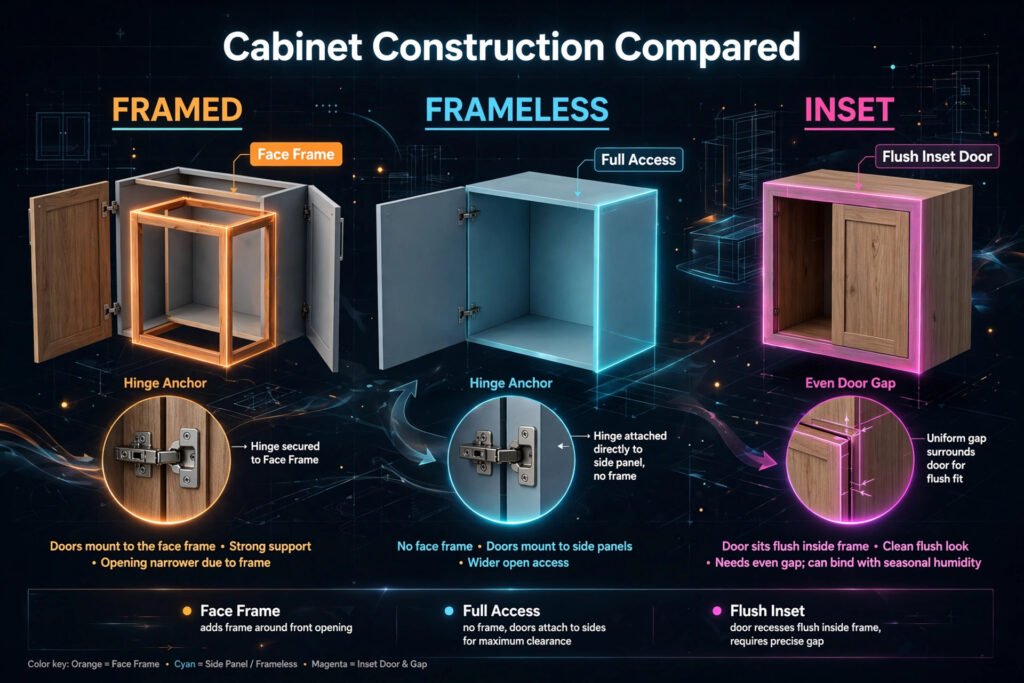
A framed cabinet has a face frame. A face frame is a wooden border, usually about 1-1/2 inches wide, on the front of the box. Hinges screw into that solid wood frame. The frame keeps the box square.
A frameless cabinet has no face frame. It is also called European or full-access construction. Doors mount straight onto the side panels. Open the door, and you get nearly the full inside width. That wider opening matters most for drawers and wide, flat items like baking sheets.
Neither build wins for every kitchen. Framed cabinets forgive uneven walls better. That matters in older homes and remodels. Frameless cabinets give more usable width. But they need careful leveling. On a wavy wall, small errors show as uneven door gaps.
Overlay describes how much frame the door covers. Partial overlay covers only part of the frame. You see a clear border around each door. That look reads traditional. Full overlay covers nearly the whole frame. Doors sit close together, and the front looks flat and modern. Inset is different. An inset door sits inside the frame, flush with it, like furniture. It is beautiful, but it is the hardest build to fit. The gap must stay even on all four sides. Wood also moves with seasonal humidity. A door that fits in dry winter air can bind, or stick, in humid summer air. Inset work needs an experienced maker and installer, and it usually costs more. For the full comparison, see this framed vs. frameless cabinet guide.
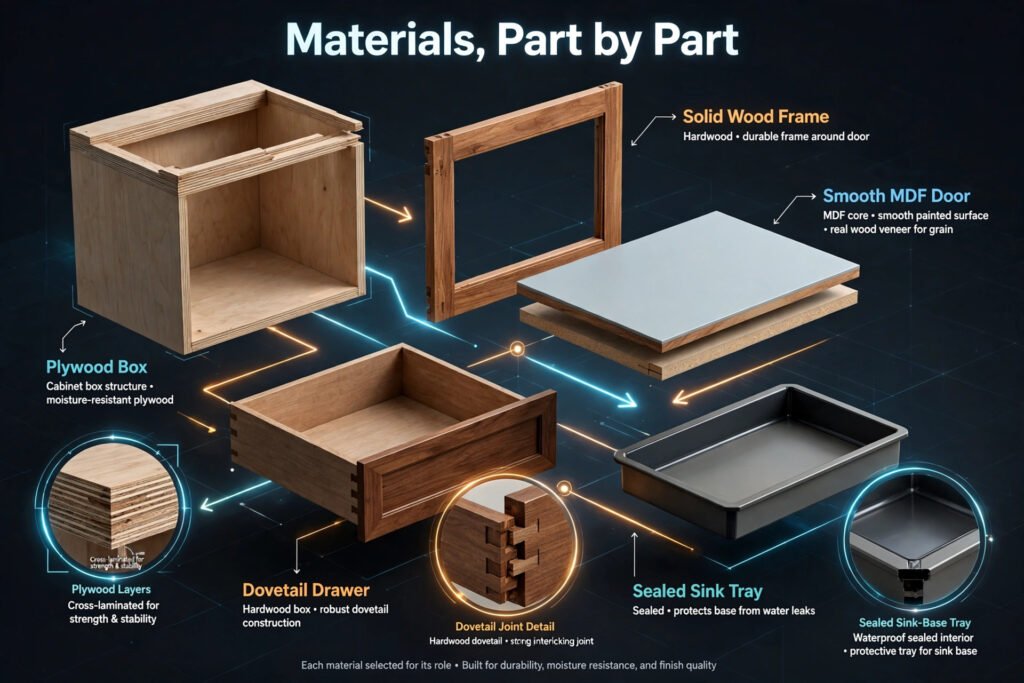
Materials and Finishes, Part by Part
“Solid wood cabinets” is an unclear phrase.
| Part | Strong luxury choice | Watch out for |
|---|---|---|
| Box | Plywood, often 1/2 inch to 3/4 inch thick | Thin particleboard, weak back panels |
| Door frame | Solid hardwood in your chosen wood | Finger-jointed stock under a clear stain |
| Door centre panel | MDF for paint, solid wood for stain | Wide solid panels under paint, which can show joint lines |
| Drawer box | Solid hardwood with dovetail joints | Stapled thin panels with a loose bottom |
| Interior | Finished plywood or melamine | Rough, unfinished interiors that stain fast |
MDF stands for medium-density fiberboard. It is wood fibers and resin pressed into a smooth panel. It has no grain, so it paints very smoothly. That makes it good for painted doors. Veneer is a thin layer of real wood on a stable core, often plywood or MDF. A walnut veneer door shows real walnut grain. It stays more stable than a wide solid walnut board.
Maple is hard, smooth, and paints well. White oak has warm, straight grain. It suits modern and traditional rooms. Walnut is dark, rich, and often most premium in price. Cherry darkens with age and suits classic rooms. Oak has open grain, so texture shows through paint. Lacquer is a sprayed coating that dries hard and smooth, almost like glass. Deep scratches need professional repair.
Thermofoil is a vinyl film wrapped over an MDF door with heat and pressure. It is smooth, easy to clean, and often lower in cost. But heat can loosen it. Keep thermofoil away from strong heat from ovens, toasters, and kettles. Follow the maker’s clearance and heat-shield rules. Laminate is a hard decorative layer fused onto a core. Melamine is a similar hard surface used inside boxes and on slab doors. The sink base is the most leak-prone cabinet. Choose a finished interior, sealed pipe openings, and a removable tray. For a full breakdown, see this cabinet material guide.
Door Styles and Looks That Read as Luxury
Shaker doors have a flat centre panel with a simple frame. Shaker doors wipe clean easily because they have few grooves. Slab doors are flat, with no frame or panel detail. They suit modern, handleless kitchens. Raised-panel doors have a centre panel that stands out from the frame. They suit classic homes, have more detail to dust, and often cost more.
Glass-front doors break up a long run of solid doors. Use them for a few upper cabinets to show glassware or pretty dishes. Two-tone kitchens use one color for main cabinets and a second color for the island. For example, pair warm white cabinets with a deep green or wood island. Handleless kitchens use push-to-open doors or a grip rail, not knobs. Your cabinet style should fit the rest of your home. Browse interior design ideas to compare cabinet color, wood tone, and hardware with flooring and lighting.
Storage That Makes Daily Cooking Easier
Most kitchens do not lack space. They lack usable space. Think of shelves you must kneel to reach, corners nobody opens, and pantries where cans hide behind cans. Plan storage into the layout from the start.
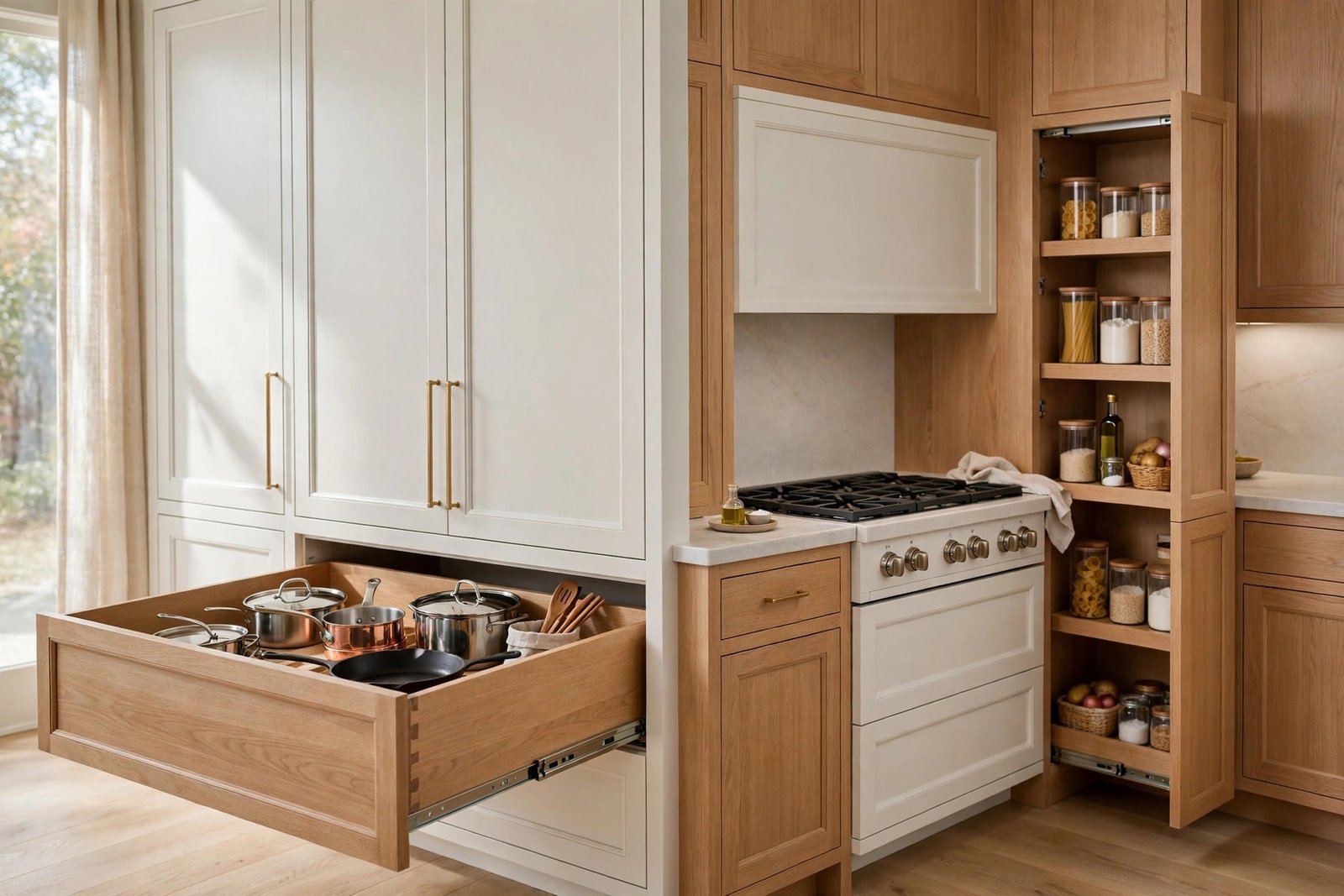
Deep drawer bases are the most useful upgrade for base cabinets. Replace a door-and-shelf base with a stack of wide, deep drawers. Pull a drawer out and look down at everything: pots, pans, lids, and dishes. You no longer kneel and dig in a dark cabinet. A tall pantry with pull-out shelves beats a deep pantry closet. Each shelf pulls toward you, so food at the back stays visible. Corners need a real plan too. A lazy Susan is a rotating shelf in a corner cabinet. A blind-corner pull-out swings and slides shelves out of the corner.
Other small upgrades add up. A trash and recycling pull-out keeps bins hidden near your prep zone. Vertical tray dividers store baking sheets and boards upright. An appliance garage hides a toaster or coffee maker behind a lift-up door. It stays plugged in and ready.
Hardware, Lighting, and Panel-Ready Details
Choose soft-close hinges and slides as standard, not extras. They stop slamming and protect the finish. Knobs suit small doors and classic styles. Long bar pulls suit drawers and modern styles.
Under-cabinet lights brighten your work surface. In-cabinet lights show dishes without glare. Panel-ready appliances are fridges and dishwashers fitted with cabinet panels. They blend into the run for a seamless look. They need exact specs early: model, panel thickness, door swing, ventilation, and service access. Give your maker the spec sheets before production starts.
What Do Luxury Kitchen Cabinets Cost?
Bob Vila puts the overall cost of kitchen cabinets at $4,000 to $13,000, with an average of $11,100. Your total depends on kitchen size, tier, materials, and what the quote includes.
Per-linear-foot pricing is a planning tool, not a final quote. It usually covers boxes, doors, standard hardware, and basic installation. It often excludes countertops, appliances, plumbing, electrical work, flooring, and special millwork like a custom range-hood surround. Those extras can add thousands of dollars. Installation alone matters too. Complex installation labor is roughly $150 to $300 per linear foot.
Size and layout move price first. More feet, taller cabinets, and more drawers cost more than plain doors. Inset doors cost more than overlay doors because they need tighter work. Exotic woods, hand finishes, glass doors, lighting, and appliance panels each add cost.
Never compare headline totals alone. Ask each seller for the same line-by-line list: cabinet count and sizes, box and drawer materials, door style and finish, hardware type, interior finish, panels, fillers, moldings, toe kicks, delivery, installation, and tax. Ask about lead time, warranty, and change costs after you approve drawings.
For example, imagine a kitchen with 20 linear feet of cabinets. At a semi-custom estimate of $150 to $650 per linear foot installed, cabinets alone would be $3,000 to $13,000. For general budget planning, explore home design topics on this site.
From Order to Installation: Timeline and Checks
Measure twice, or have a professional measure for you. Choose appliances early and share their spec sheets. Order finish samples and check them at home in morning and evening light. Review drawings in full. Check each cabinet size, appliance opening, and filler.
Safety note: do not move electrical wiring, plumbing, or gas lines yourself. Hire a licensed professional for that work. Do not remove heavy old wall cabinets alone. A falling wall cabinet can cause serious injury.
When cabinets arrive, check each box against your order before work starts. Note damage in writing at once, with photos. At the end, walk the kitchen with the installer and make a punch list. A punch list is a written list of small fixes: a door adjustment, a scratch touch-up, a filler trim. Do not sign off until the punch list is done or has a clear completion date.
Care That Keeps Them Looking New
For most finishes, wipe with a soft, damp microfiber cloth and mild soap. Avoid abrasive sponges, scouring powders, and cleaners with ammonia or strong solvents. They can dull paint, lift edges, and damage lacquer.
For painted cabinets, keep a touch-up kit with the exact paint name and code. Dab small chips early with a fine brush. For stained wood, soften small scratches with a matching marker, but test it in a hidden spot first. For lacquer, leave deep scratches to a professional. Home repair on lacquer often makes marks more visible. Large shifts, swelling, or a musty smell near the sink may mean a leak. Fix the leak first, then repair the cabinet.
Mistakes to Avoid Before You Sign
Use this checklist before you pay a deposit:
- Do not order from a headline price without a line-by-line quote.
- Do not accept “solid wood” without asking which parts are solid wood.
- Do not skip samples, or judge color only under showroom lights.
- Do not order cabinets before you pick appliances and share their specs.
- Do not choose inset doors without asking about seasonal movement and adjustment service.
- Do not place thermofoil doors where heat clearances are tight.
- Do not forget the sink base: ask for a sealed interior and a protective tray.
- Do not ignore lead time. Confirm the schedule in writing if you need the kitchen by a fixed date.
- Do not skip the drawings review. Check heights, appliance openings, and fillers.
- Do not sign off on installation until the punch list is complete.
- Do not do electrical, plumbing, gas, or heavy wall-cabinet work yourself. Hire licensed help.
If a seller rushes you past any step, pause. A good cabinet maker welcomes careful questions.
Frequently Asked Questions
How much do luxury kitchen cabinets cost?
There is no single national price. Bob Vila puts the overall cost of kitchen cabinets at $4,000 to $13,000, with an average of $11,100. Per linear foot installed, stock runs $100 to $300, semi-custom $150 to $650, and custom $500 to $1,200. For example, 20 linear feet at semi-custom rates gives $3,000 to $13,000 for cabinets alone.
Are framed or frameless cabinets better for a luxury kitchen?
Neither is better for every kitchen. Framed cabinets suit older homes and remodels. The face frame forgives uneven walls and gives hinges a solid wood anchor. Frameless cabinets suit new builds and drawer-heavy kitchens. They give a wider opening and a flat, modern face.
What is the best material for luxury kitchen cabinets?
There is no one best material. Each part needs a different one. Plywood is strong for boxes. Solid hardwood suits door frames and stained fronts. MDF gives the smoothest painted doors. Wood veneer gives real grain with better stability than wide solid boards. Judge a cabinet by its full part-by-part spec.
How long do luxury kitchen cabinets last?
It depends on tier, build, and care. As planning estimates, stock often lasts 10 to 15 years, semi-custom 15 to 25 years, and custom 25 to 50 years.
Are luxury kitchen cabinets worth it, or is semi-custom enough?
For most standard kitchens, well-made semi-custom cabinets are enough. They give plywood boxes, good hardware, and wide finish choices at a lower cost than full custom. Full custom is worth the premium for an unusual layout, a rare wood or door shape, inset work done well, or a long-term home you can refinish and repair.
A Practical Way to Decide
Luxury kitchen cabinets are not about buying the most expensive option. They are about the right build: a strong box, drawers that glide under load, a finish that survives daily cooking, and a layout that makes storage easy. Take the checklist in this guide to your next showroom visit. Get two or three quotes on the same basis. Then choose cabinets that fit your kitchen, your cooking, and your budget.