
Interior Design for Beginners: A Simple Room-by-Room Method
Interior design for beginners is simply arranging a room so it works well, fits the people who use it, and feels calm to be in. It is not about buying expensive furniture or copying a showroom. It is a short list of decisions, made in the right order.
That order matters more than taste. Most beginner mistakes are not bad taste. They are good pieces bought in the wrong order. This guide walks through the five decisions one by one, so you can improve a room without guessing, overspending, or starting over.
Start Here: Interior Design Is a Sequence, Not Shopping
Shopping first feels productive, but it is the most expensive way to decorate. A room designed by shopping alone usually ends up with pieces that do not work together. Start with a plan instead: decide what the room must do, measure the space, and only then choose colors and pieces.
Here is the sequence this guide uses:
- Decide what the room must do.
- Measure the room.
- Choose a color recipe.
- Get the sizes right.
- Plan the lighting.
- Edit — remove one thing before you add one thing.
Work through one room at a time. Finish the living room before you start the bedroom, so you learn the method once and repeat it with confidence.
Step 1: Decide What the Room Must Do
Every room has one main job. A living room is mainly for sitting together. A bedroom is mainly for sleep. A home office is mainly for focused work. Write the main job down, even if it sounds obvious. It becomes your filter: if a piece does not help the main job, it waits.
Then list the secondary jobs. A living room might also host guests, hold books, and serve as a reading corner. A bedroom might also need a dressing area. Keep the list short — one main job and at most two secondary jobs. A room asked to do five jobs usually does none of them well.
Next, think about zones. A zone is just an area for one job. In a living room, the seating area is one zone and a reading chair by the window is another. You do not need walls to make zones. A rug, a lamp, or the direction chairs face can mark a zone clearly enough.
Ask three questions before you move on: Who uses this room most? What do they do here every day? What frustrates them about the room now? The answers tell you what to fix first, and they stop you from copying a beautiful room that solves someone else’s problem.
Step 2: Measure Before You Buy Anything
Measuring takes about 20 minutes and saves more money than any sale. You need a tape measure, a phone or paper for notes, and the room empty of any pieces you are unsure about.
Measure the length and width of the room. Then measure each wall, the height of the ceiling, and the width of doors and windows. Note where doors swing, where radiators or vents sit, and where power outlets are. A sofa that covers the only outlet near a reading chair is a daily annoyance, and it is entirely avoidable.
Also measure your walkways. Leave enough space to walk comfortably around furniture — in a living room, that usually means clear paths you can walk without turning sideways. If a coffee table leaves only a narrow gap to the sofa, the table is too big or too close, no matter how good it looks.
Write the measurements on one page and keep it on your phone when you shop. Check every large purchase against it: Will it fit through the door? Will it fit along the wall with space left over? Will you still be able to open the door and walk past it? If you cannot answer yes to all three, do not buy it yet.
Step 3: Choose Color With the 60-30-10 Recipe
Color feels risky to beginners because there are thousands of choices. The 60-30-10 rule turns that choice into a recipe. Use one dominant color for about 60 percent of the room, a secondary color for about 30 percent, and an accent color for about 10 percent.
In practice, the 60 percent is usually the walls and large surfaces. The 30 percent is the big furniture, rugs, and curtains. The 10 percent is the small things: cushions, throws, art, and accessories. You do not need to measure percentages exactly. The idea is proportion: mostly one calm color, a good amount of a second color, and just a touch of a bold one.
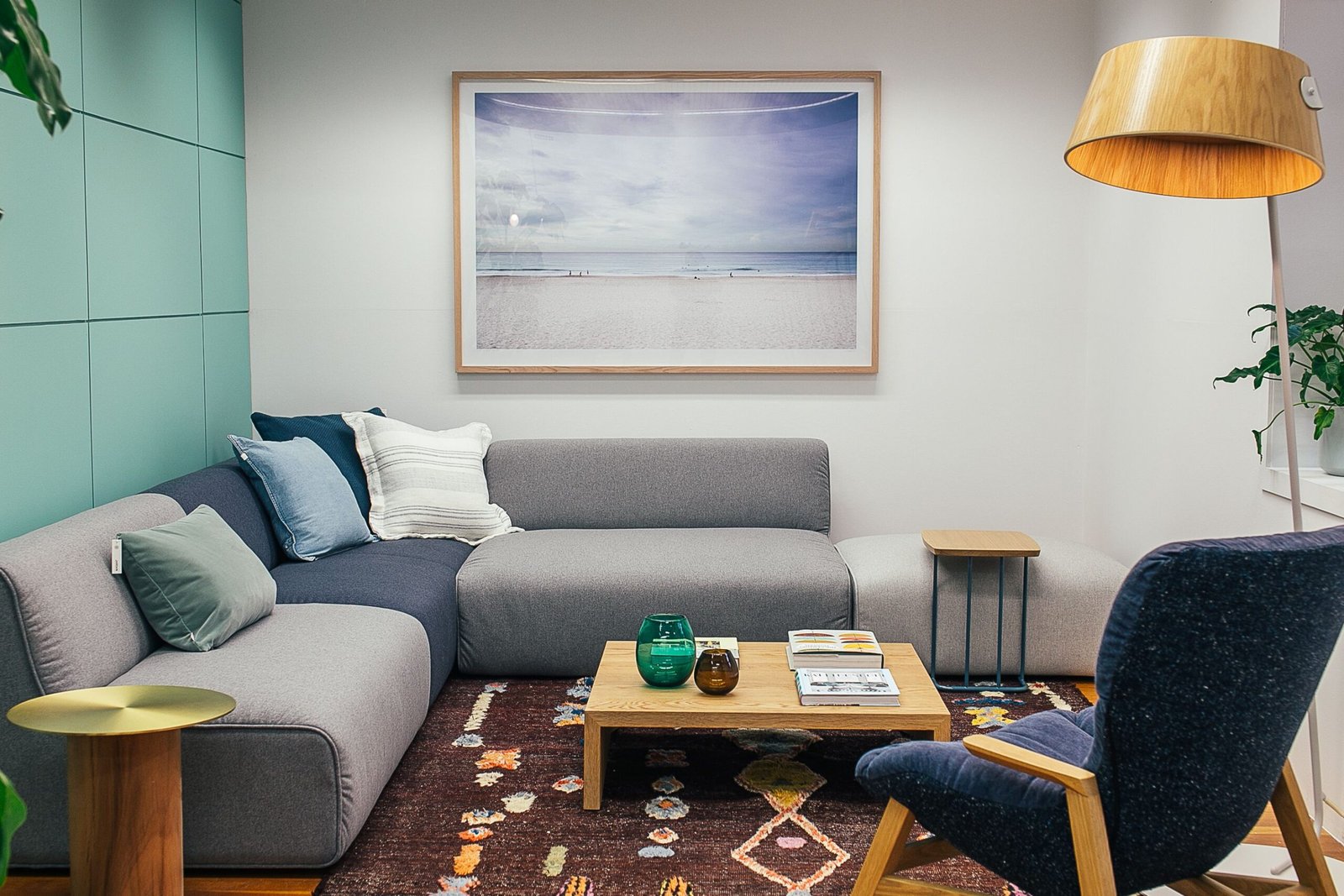
Here is an example palette you can adapt. Walls in a warm off-white (60 percent), a sofa and rug in soft sage green or warm gray (30 percent), and cushions and art in a deep terracotta or navy (10 percent). The room feels calm because most of it is quiet, and it feels alive because the small accent color repeats in a few places.<
Test paint in your own light
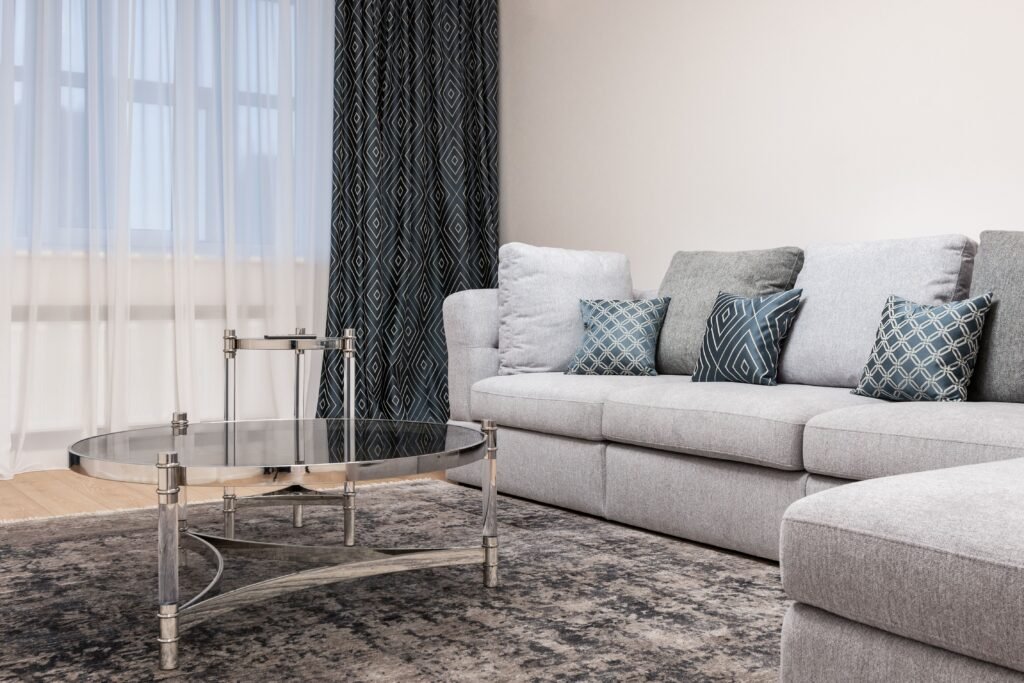
Paint is the one decision you should never make in the shop alone. Shop lighting is bright and even. Your room has morning light, evening light, and lamplight, and each one changes how a color looks. Paint a large sample on the wall or on a board you can move around the room. Live with it for two days and look at it in daylight and at night before you commit.
The same rule applies to fabric. Hold a cushion or curtain sample against your sofa in your own room before you buy. A color that looks calm in a shop can look loud next to your walls, and the only way to know is to test it where it will live.
Step 4: Get Scale Right Without Guessing
Scale means whether furniture looks the right size for the room and for the other pieces in it. A tiny rug under a large sofa makes the sofa look stranded. A huge sofa in a small room makes the whole room feel cramped, even if the sofa itself is comfortable.
Use these rules of thumb:
- Rug: The front legs of the sofa and chairs should sit on the rug. A rug that only fits under the coffee table is usually too small.
- Sofa: Leave space on both sides of the sofa where possible, and do not let it run wall to wall unless the room is very small. A sofa that fills the whole wall leaves no room for a side table or lamp.
- Art: Hang art at eye level when you are standing, and choose a piece that is roughly two-thirds the width of the furniture below it. One medium piece usually looks better than four tiny frames scattered across a wall.
- Coffee table: Leave enough room to walk around it and to set a cup down without stretching. If you have to stand up to reach it, it is too far from the sofa.
When in doubt, mark the footprint on the floor with painter’s tape before you buy. Tape the outline of a sofa or rug on the floor, live with it for a day, and walk around it. You will learn more from tape on the floor than from a photograph of the piece in a showroom.
Step 5: Light in Three Layers
Most beginner rooms have one light: a ceiling fixture that is either too bright or too dim. Good rooms use three layers, and each layer has a job.
- Ambient light is the general light for the whole room, usually from a ceiling fixture or several wall lights.
- Task light is focused light for doing something: a reading lamp by a chair, a desk lamp, or lights over a kitchen counter.
- Accent light is soft light that highlights something you like: a picture light, a small lamp on a shelf, or a light that washes a textured wall.

You do not need all three on at once. In the evening, you might use a soft ambient light plus one reading lamp. That combination feels warmer and more relaxed than a single bright ceiling light, even at the same total brightness.
Two words help when you shop for bulbs. Kelvin (K) measures the color of light. Lower numbers are warmer and more yellow; higher numbers are cooler and more blue-white. For living rooms and bedrooms, warm white around 2700K to 3000K usually feels comfortable. For kitchens, bathrooms, and work areas, neutral white around 3500K to 4000K gives clearer light for tasks. Very cool light above 5000K can feel clinical in a home and is best avoided in living spaces.
Lumens measure brightness. Watts measure energy use, so with modern LED bulbs, watts no longer tell you how bright a bulb is. As a rough guide, a bulb around 800 lumens gives about the same light as an old 60-watt bulb. Check the lumens on the box, not just the wattage.
For fixture size, one handy rule is to add the room’s length and width in feet and read that number as inches. A 12-foot by 14-foot room points to a fixture roughly 26 inches across. Undersized fixtures are a common beginner error — the fixture looks lost, and the room feels unfinished. Also keep about 7 feet of clearance under a fixture in a walkway, so tall guests do not duck.
A safety note: this guide covers plug-in lamps and bulb changes only. If a project involves new wiring, moving outlets, or working inside a fixture’s wiring, hire a licensed electrician. Do not open electrical boxes or rewire circuits yourself.
The One-Room Starter Plan: A 12 × 14-Foot Living Room
Here is how the five decisions come together. This is a labeled example, not a rule for every room. Imagine a 12-foot by 14-foot living room with one window, a door on one short wall, and a family that watches films, reads, and hosts two or three friends.
- Main job: comfortable seating for four. Secondary jobs: reading and hosting.
- Measure: the long wall fits a sofa up to about 84 inches with space for a side table. Walkways are kept clear on the door side.
- Color: warm off-white walls (60 percent), a soft gray-green sofa and rug (30 percent), terracotta cushions and one piece of art (10 percent).
- Scale: an 84-inch sofa, a rug large enough for the sofa’s front legs and two chairs, art about two-thirds the sofa’s width above it.
- Light: a ceiling fixture around 26 inches across for ambient light, a floor lamp by the reading chair for task light, and a small table lamp on the side table for accent light. Warm white bulbs around 2700K to 3000K in the living areas.
- Edit: one coffee table, not two; one large plant, not five small pots; books on one shelf, not every surface.
Buy in this order: rug first (it sets the color and the zone), then sofa, then lighting, then cushions and art last. Cushions are the cheapest way to fix a color mistake, so they go last on purpose. If the rug is wrong, everything built on it will feel wrong, so choose the rug slowly and the cushions quickly.
Beginner Mistakes That Cost the Most
- Buying furniture before measuring. It is the single most expensive beginner mistake, because returns are costly and a wrong sofa dominates the room.
- One harsh ceiling light. A single bright source flattens a room and makes it feel like an office. Add a lamp before you buy more furniture.
- Choosing paint in the shop. Always test a sample in your own light for two days.
- Filling every wall and surface. Empty space is not unfinished. It is what lets the pieces you love stand out. Remove one item before you add one.
- Buying everything at once. Rooms that grow slowly look collected and personal. Rooms bought in one weekend often look like a showroom and feel less like home.
If You Rent: What Still Works
Renters can use the same method with removable changes. Choose a rug, lamps, cushions, and art that you can take with you. Use removable hooks or leaning art where drilling is restricted, and check your lease or ask your landlord before making any fixed change. Paint is sometimes allowed with permission and a promise to repaint — ask first, in writing, rather than assuming.
A renter’s best investment is lighting and textiles. A good floor lamp, a large rug, and curtains that fit the window change a room more than a new sofa, and they move with you to the next home.
If you want more ideas for putting your plan into practice, explore the interior design styles guide and a practical living room layout for arranging your seating zones.
Frequently Asked Questions
Where do I start with interior design?
Start with the room’s main job, then measure. Those two steps cost nothing and prevent the most expensive mistakes. Choose color and lighting after that, and shop last. If you only do one thing this weekend, measure the room and write the numbers on your phone.
How many colors should a room have?
Three is a good beginner number: one dominant, one secondary, and one accent, roughly in a 60-30-10 split. You can use shades of the same color within each group. More than three strong colors usually needs a confident hand to keep the room calm.
What is layered lighting?
Layered lighting means using ambient light for the whole room, task light for activities like reading, and accent light to highlight something you like. Most rooms feel better with two or three soft sources than with one bright ceiling light, because you can adjust the mood for the time of day.
How big should a light fixture be?
As a rule of thumb, add the room’s length and width in feet and use that number as the fixture’s diameter in inches. A 12-foot by 14-foot room points to about a 26-inch fixture. This is a starting point, not a strict rule — a very tall ceiling or a long dining table can change the choice.
Do I need to buy everything at once?
No, and it is usually better not to. Buy the rug and the largest seating first, then lighting, then smaller items last. Living in a room for a few weeks between purchases teaches you what is actually missing, and it spreads the cost.
Pick one room, make the five decisions in order, and buy the rug before anything else. That single change in order is often the difference between a room that looks assembled and a room that feels like home.
Disclaimer — This article shares general design information only. Homes, budgets, and needs vary. For electrical wiring, structural changes, or major installations, hire a qualified professional.


One Comment