

What Is Luxury Furniture? Beyond the Price Tag
Luxury furniture is furniture defined by the quality of its materials, the skill of its craftsmanship, the thoughtfulness of its design, and how well it holds up to daily life — not by its price tag alone. A luxury piece is usually made from premium materials such as solid wood, fine leather, or natural stone, built with care and strong joinery, designed to stay stylish for years, and comfortable enough to use every day. Price often follows quality, but a high price by itself proves nothing.
That last sentence is the most useful idea in this guide. Anyone can attach a high price to a chair, but luxury is something you can see, touch, and test: the material under the finish, the way the joints hold, the evenness of the stitching, and the way the piece feels after you sit in it. Learn those tests, and no label can fool you.
What Luxury Furniture Is Not
Before the definition helps, four common misunderstandings need clearing away.
Luxury is not the same as expensive. An expensive piece can be poorly made, and a well-made piece can be fairly priced. Carrocel’s high-end furniture guide makes exactly this point: anyone can attach a higher price tag and label a piece “luxury,” but price alone does not define quality. True high-end pieces combine materials, craftsmanship, and long-term value.
Luxury is not the same as fashionable. A trendy piece follows this season’s look. A luxury piece usually follows a timeless design — balanced proportions, clean lines or classic detailing — that still looks right years later. Fashion fades; proportion lasts.
Luxury is not the same as delicate. Some luxury pieces are delicate, but many are built for daily family life: solid frames, durable fabrics, and finishes that can be maintained or repaired. A sofa nobody dares to sit on has failed at its main job.
Luxury is not the same as branded. A famous name can signal quality, but it can also signal marketing. Judge the piece in front of you, not the logo on it. The five checks below show you how.
The Five-Check Inspection
This inspection is the original practical tool of this guide. You can run it in a store, a showroom, or at home when a delivery arrives. It takes about five minutes per piece, and it works for sofas, chairs, tables, beds, and storage alike.
Check 1: The material test
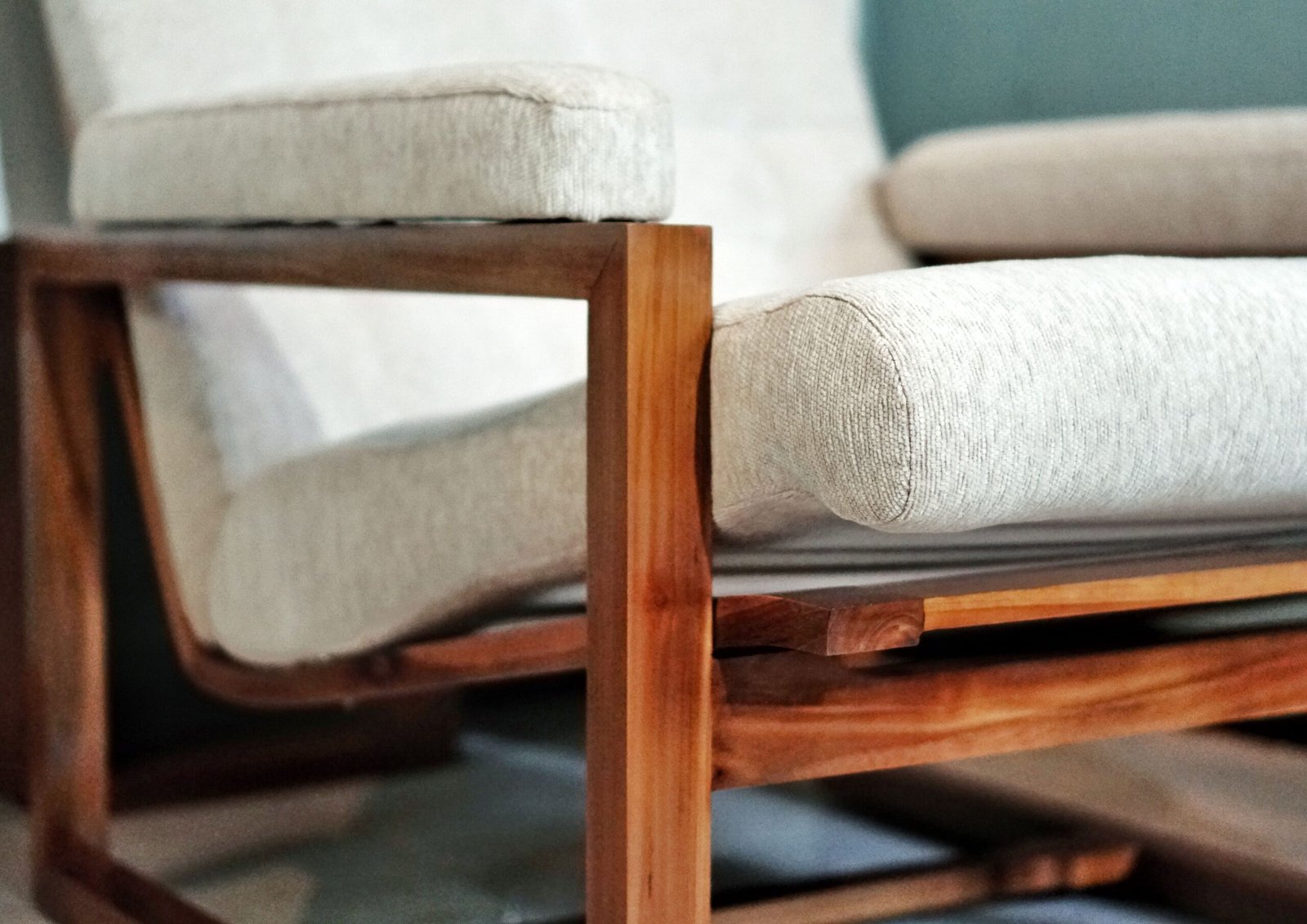
Ask what the piece is actually made of, and look for yourself. Solid wood has grain that continues around edges and into corners; a printed wood-look surface repeats its pattern and stops at the edge. Lift a cushion and look underneath: a quality frame is usually solid wood or a strong engineered hardwood frame, not thin, flimsy board. For upholstery, feel the fabric or leather. Fine leather feels supple and slightly irregular, because it comes from an animal hide. Good textiles feel dense and substantial, not thin and papery. If a seller cannot or will not tell you the frame material, treat that as information too.
Check 2: The joint test
Joints are where furniture lives or dies. Gently rock chairs and tables side to side. A well-built piece feels firm and quiet. Creaking, wobbling, or visible gaps at the joints warn of weak construction. Open and close drawers: they should glide smoothly, sit straight when closed, and feel solid rather than hollow. Look underneath and inside where makers hide their shortcuts — the underside of a table, the back of a cabinet, the inside of a drawer. Quality makers finish even the places you rarely see.
Check 3: The finish test
Run your hand along edges, seams, and surfaces. Finishes on luxury pieces are even and smooth, with no rough patches, drips, or sharp edges. Stitching on upholstery should be straight, even, and tight, with matching thread and no loose ends. On wood, the finish should feel like part of the piece, not a thick plastic coat sitting on top of it. Check corners and curves especially, because rushed work shows there first.
Check 4: The comfort test
Sit in it the way you actually sit. Sit for several minutes, not seconds. Lean back, put your feet up if that is how you live, and notice whether the seat supports you evenly or sags to one side. Cushions should spring back rather than hold a dent. A dining chair should support your back at the table, not just look good beside it. A bed frame should feel silent and firm when you move, not creaky and springy. Comfort is not a luxury extra. It is one of the defining traits of luxury furniture, and a beautiful piece that hurts to use is not luxurious.
Check 5: The story test
Ask five short questions: Who made this? Where was it made? What are the frame and fill materials? Can it be repaired, and are replacement parts or fabric available? What care does it need? A trustworthy seller or maker answers plainly. Vague answers, pressure to decide quickly, or claims you cannot verify — “handcrafted” with no maker named, “solid wood” on a piece that is clearly veneered board — are reasons to pause. A piece with a clear story is usually a piece someone stood behind.
A piece that passes all five checks is worth serious consideration at almost any price. A piece that fails two or more is not luxury, whatever its tag says.
Materials in Plain Language
Materials are the vocabulary of luxury furniture. You do not need to become an expert, but knowing the main families helps you read a label and ask better questions.

Solid woods. Walnut, mahogany, oak, and teak are the classic luxury woods, chosen for beauty, strength, and longevity. Solid wood can be repaired, refinished, and passed on. Veneer — a thin layer of fine wood over a core — is not automatically bad; good veneer over a strong core is a legitimate, stable construction method. The difference that matters is what lies underneath and how well it is joined.
Leather. Fine leather is durable, breathes, and develops character with age. It needs occasional cleaning and conditioning, and it dislikes long hours of direct sunlight. Not all “leather” labels mean the same thing: full-grain and top-grain leathers are generally higher quality than bonded leather, which is made from leather fibers pressed together. If a label does not say which kind it is, ask.
Textiles. Silk and velvet bring softness and sheen, while high-quality linen and cotton bring breathability and texture. Dense weaves and higher thread counts usually signal durability, but the real test is touch: a good fabric feels substantial and holds its shape. Removable, washable covers are a practical luxury for family homes.
Stone and metal. Marble, granite, and other natural stones appear in tabletops and accents, bringing weight and permanence. Brass, bronze, and stainless steel appear in legs, handles, and details. Il Piccolo’s luxury furniture guide lists the same family of materials — fine woods such as mahogany, walnut, and oak, leather, silk, and velvet, plus gold, silver, and bronze details — and notes that luxury pieces are often handcrafted and custom-made, which lets makers control quality at every stage.
Fills and cushions. Inside a sofa or chair, the fill decides comfort and lifespan. High-resilience foam, feather-and-down wraps, and spring systems each feel different, and good makers combine them deliberately. Ask what is inside, and sit long enough to feel whether support is even from edge to edge.
Luxury vs Ordinary Furniture
The table below compares the two categories in general terms. Individual pieces vary, and a well-made ordinary piece can beat a poorly made expensive one — which is exactly why the five checks matter more than the category name.
| Feature | Luxury furniture | Ordinary furniture |
|---|---|---|
| Materials | Premium naturals: solid wood, fine leather, silk, velvet, stone, brass | Often engineered wood, common textiles, plastic or thin metal details |
| Craftsmanship | Handcrafted or carefully hand-finished; strong joinery; finished even where unseen | Machine-made at speed; staples and glue where joinery would be stronger |
| Design | Timeless or distinctive proportions; made to outlast trends | Trend-led or generic; replaced when tastes change |
| Comfort | Designed for daily use; even support; cushions recover their shape | Comfort varies; cushioning may flatten or sag sooner |
| Durability | Built to last decades with care; often repairable | Built for a few years of use; harder to repair |
| Availability | Limited production, bespoke, or custom options common | Mass-produced in large quantities |
| Price | Usually higher, reflecting materials and labor | Usually lower, reflecting faster production |
Two cautions keep this table honest. First, “lasts decades” assumes normal use and reasonable care, not indestructibility. Second, no piece gains value automatically. Some well-known designs hold their resale value, and some do not, and resale value should never be the main reason to buy furniture for your own home.
Comfort and Daily Life
Luxury furniture earns its place by how it handles real life, not by how it photographs. Before buying, imagine the piece on its worst day in your home: children climbing on the sofa, a guest spilling coffee, a dog claiming the favorite chair, a heavy holiday meal on the dining table. The right luxury piece survives those days with cleaning and care, not panic.
That is why practical details count as luxury features. Removable cushion covers, a finish that can be touched up, a frame that can be re-glued by a furniture repairer, and a maker who sells replacement parts all extend a piece’s life far more than a decorative detail does. When choosing between two beautiful pieces, pick the one whose care routine you will actually follow. A velvet sofa in a house full of pets and toddlers may be a beautiful mistake, while a sturdy leather or performance-fabric version of the same design could be a daily pleasure.
Scale matters too. A luxury piece that overwhelms its room is not luxurious in that room. Measure doorways, stair turns, and the room itself before ordering, and leave walking space around the piece. The most expensive sofa in the world looks wrong if it blocks the path to the kitchen.
Buying Wisely
You do not need a showroom budget to buy well. You need patience and good questions.
Start with the piece you use most. A bed, a sofa, or a dining table you use daily repays quality far more than a rarely used accent chair. Spend where your life happens, and save where it does not.
Compare in person when you can. Sit on the sofa, open the drawers, and run the five checks. Photos hide joints, finishes, and comfort. If you must buy online, read the materials list carefully, check the return policy before ordering, and run the five checks the moment the piece arrives.
Consider custom and bespoke options. Custom-made furniture lets you choose dimensions, materials, and fabrics for your exact room. It usually costs more and takes longer, but it solves awkward spaces and personal needs that ready-made pieces cannot. Ask any maker for a written specification of materials before you commit.
Consider secondhand luxury. Well-made pieces often outlive their first owners, and secondhand markets can offer genuine quality at lower prices. Run the same five checks, and check stability, smell, and condition carefully. A pre-owned luxury piece in good condition is often a better buy than a new ordinary piece.
Ask about repair and care before you pay. Can the frame be repaired? Are covers replaceable? What cleaning products are safe? A maker or seller who answers these questions clearly is selling a piece meant to last. One who cannot answer them may be selling a look, not a lifetime piece.
Living With Luxury Pieces
Luxury furniture asks for steady, simple care rather than constant fuss. Dust wood with a soft, dry cloth. Clean leather and textiles with products suited to the material, and test any cleaner on a hidden spot first. Keep wood and leather out of long hours of direct sunlight, which dries and fades them. Use coasters and pads under hot or wet items on stone and wood surfaces, and wipe spills promptly rather than letting them sit.
Know when to call for help. A loose screw or a squeaky hinge is a small home fix. A broken joint, a sagging frame, or a torn seam belongs to a qualified furniture repairer, who can often restore a piece to full use. Good repair is part of luxury ownership: a piece that can be fixed is a piece that can stay in your home for decades.
Finally, let the piece earn its place. A luxury item should make daily life more comfortable, not more anxious. If you find yourself guarding a chair from your own family, the piece may be wrong for this stage of your life — and that is useful information, not a failure. The best luxury furniture is the furniture you actually live with, every day, with pleasure.
Frequently Asked Questions
What is luxury furniture?
Luxury furniture is furniture defined by premium materials, skilled craftsmanship, thoughtful design, comfort, and durability — not by price alone. Typical materials include solid wood, fine leather, natural stone, and quality textiles, built with strong joinery and finished with care.
Is expensive furniture always luxury furniture?
No. A high price does not guarantee quality materials or craftsmanship. Some expensive pieces are ordinary furniture with a designer label or a fashionable look. Use the five-check inspection — materials, joints, finish, comfort, and story — to judge the piece itself.
How can you tell if furniture is high quality?
Check the frame material, test the joints for firmness, feel the finish for smoothness, sit in the piece for several minutes, and ask the seller about materials, maker, repairs, and care. Quality shows in places makers think you will not look, such as the underside and inside of drawers.
What materials are used in luxury furniture?
Common materials include solid woods such as walnut, mahogany, oak, and teak; fine leather; silk, velvet, and high-quality linen or cotton; natural stone such as marble; and metals such as brass, bronze, and stainless steel.
Is luxury furniture worth the money?
It can be, when the piece is well made, comfortable, suited to your daily life, and built to last decades with care. It is less worthwhile when you pay mainly for a label, a trend, or a look that does not suit how you live. Start with the pieces you use most, and judge each one with the five checks.
How do you take care of luxury furniture?
Dust wood with a soft, dry cloth, clean leather and textiles with products suited to the material, keep pieces out of long hours of direct sunlight, wipe spills promptly, and use coasters under hot or wet items. For broken joints, sagging frames, or torn seams, consult a qualified furniture repairer.
Judge the Piece, Not the Price
The next time a price tag tries to tell you a piece is luxurious, ignore it for five minutes. Feel the material, rock the joints, check the finish, sit in it properly, and ask its story. A piece that passes those checks has earned the word luxury, whatever its price. A piece that fails them has not, whatever its label claims.
Once you know what to look for in a piece, choose the room it belongs in with the main interior design styles explained and our guide to create a cozy bedroom.
Disclaimer This article offers general design information, not advice for your specific home or purchase. Materials, construction, and durability vary by maker and piece, so inspect each item yourself before buying. For repairs or restoration, consult a qualified furniture professional.

One Comment