

Decorating a Dining Room Wall: Simple Ideas That Make the Room Feel Finished
A blank dining room wall makes the whole room feel unfinished, even when the table and chairs are perfect. The fix is simpler than most people think: pick one wall to focus on, choose decor that fits the furniture below it, and hang it at eye level. That is the whole secret. Everything else is just picking the style you like.
This guide covers how to choose the right wall, how big your art should be, how high to hang it, and which ideas fit your room and budget — most in a single weekend.
What a Dining Room Wall Needs to Do
A dining room wall has a harder job than a hallway wall. People sit close to it for an hour at a time, chairs slide back against it, and the light changes from bright lunch to soft candlelight at dinner.
So the wall needs to do three things at once: give the room a focal point, survive daily life with nothing fragile at chair-back height, and feel like you. Our guide to interior design for beginners starts the same way for any room: look before you buy.
Pick Your Focal Wall First
Every dining room has one wall that wants the attention. It is usually the wall you face when you sit at the head of the table, or the first wall you see when you walk in. In many homes, it is the wall behind the sideboard or buffet.
Pick that wall and decorate only it first. One finished wall looks better than four half-decorated walls. You can always add to the other walls later, but starting with one keeps the room calm instead of busy.
In an open plan, the focal wall also marks where the dining area ends and the living room begins. Our guide to living room layout shows how one strong wall can define that zone.
The Size and Height Rules That Make Art Look Right
Most dining room walls look wrong for the same two reasons: the art is too small, or it hangs too high. Both are easy to fix once you know the numbers.
How wide should it be?
Use the furniture below as your ruler. A piece of art, a mirror, or a grouping should be about two-thirds to three-quarters as wide as the table or sideboard underneath it. In other words, aim for 60 to 80 percent of the furniture’s width.
A 48-inch sideboard wants art that is roughly 32 to 38 inches wide. If the art is narrower than half the furniture, it looks lost. If it is wider than the furniture, it looks top-heavy.
This rule works for a single piece and for a group. For a gallery wall, measure the whole group as one rectangle. Our guide to TV wall ideas uses the same width rule for a screen above a console.
How high should it hang?
Center the art at eye level, about 57 to 60 inches from the floor to the center of the piece. That is the height museums use, and it works in dining rooms because people look at the wall both standing and sitting.
When art hangs above a sideboard, leave 6 to 8 inches between the top of the furniture and the bottom of the frame. That gap keeps the art connected to the furniture without crowding it. If the gap is much bigger, the art floats.
Spacing that keeps it calm
When you hang more than one piece, keep the spacing even. Two to 3 inches between frames is the standard gap, and it works for grids, rows, and loose groupings alike. Wider gaps make the group fall apart. Tighter gaps make it look crowded.
One Big Piece of Art
If you want the fastest change, hang one oversized piece of art. A single large canvas or framed print can finish a whole wall in ten minutes, and it is easier to style than a dozen small pieces.
Go bigger than you think. A piece that feels slightly too large in the store usually looks just right on the wall. Small art on a big wall is the most common mistake in dining rooms.
Choose art with a color that already appears in the room — one color from the rug, the chair fabric, or the curtains is enough. Avoid anything too busy or too dark for a small room, because a heavy piece can make the walls close in. The Spruce’s guide to modern dining room ideas shows how one oversized piece can warm up a modern dining room without changing anything else.
Build a Gallery Wall That Looks Collected, Not Cluttered
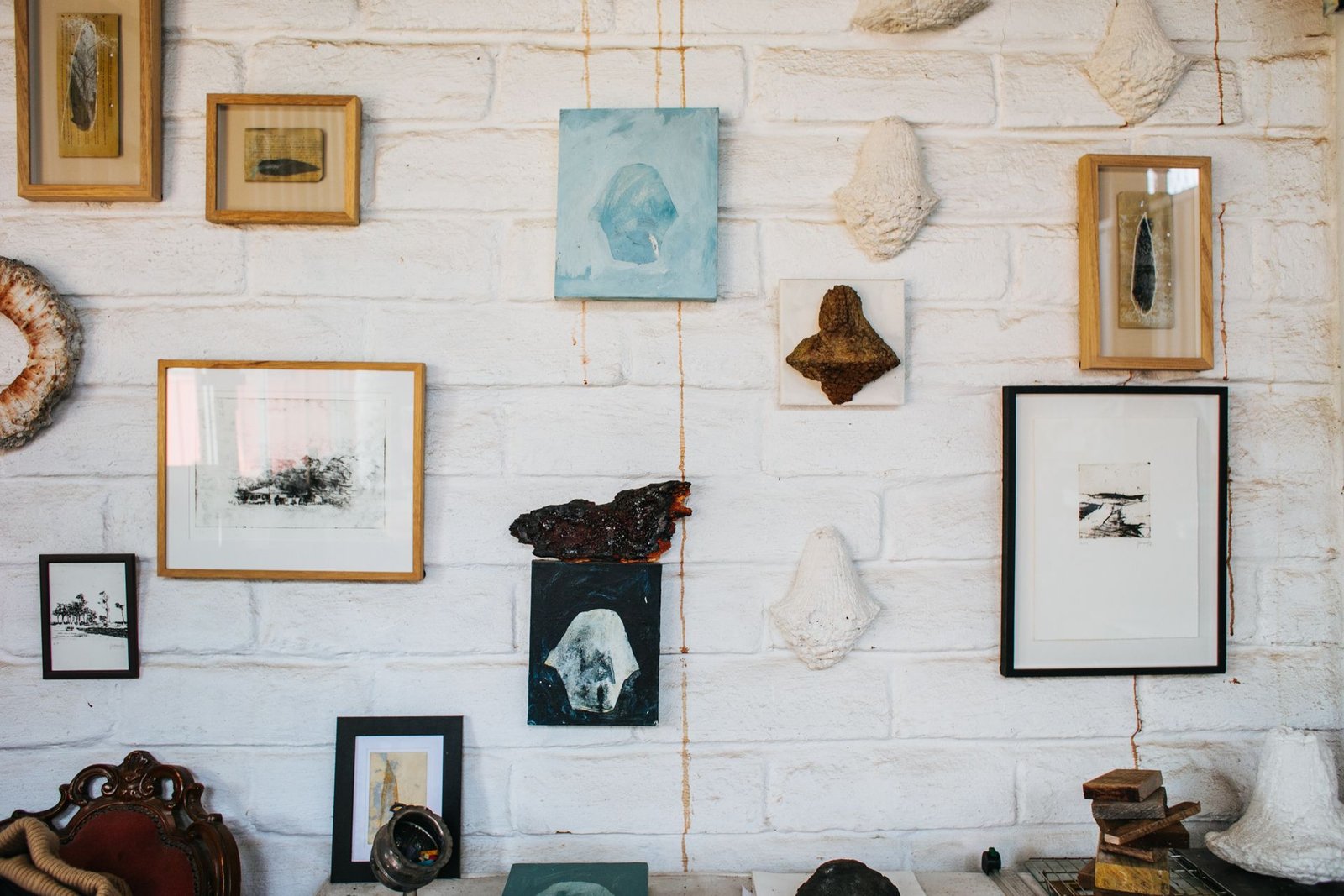
A gallery wall is a group of framed pieces arranged together on one wall. It is the most personal option on this list, because it can hold family photos, travel prints, sketches, and small paintings side by side. Done well, it feels layered and lived in. Done badly, it looks like frames that fell on the wall. The difference is planning.
Three layouts that work
A grid is the calmest layout. Use six to twelve frames in the same size, with the same spacing, in neat rows. It suits formal dining rooms. Botanical prints, black-and-white photos, or architectural drawings look especially good in a grid.
A salon wall is looser. Mix frame sizes and shapes, but connect them with one color or one frame finish. Start with the largest piece near the center, then work outward with smaller pieces. This layout suits casual dining rooms and rooms with a collected, traveled feel.
A mirror-centered gallery puts a mirror in the middle and frames around it. The mirror reflects the chandelier and the table, which adds sparkle at dinner and makes the room feel larger. Two or four frames around the mirror keep it balanced.
Pick one layout and stick to it. Add one or two personal pieces — a framed menu from a favorite restaurant, postcards from a trip, a child’s drawing in a good frame — because those are the pieces guests ask about.
Plan it on paper first
Before you drill, lay the frames on the floor and arrange them. Then cut paper templates the size of each frame, tape them to the wall, and live with them for a day. This one step prevents most gallery wall mistakes.
Check the templates from every seat at the table, and in the evening light too. When you are happy, hang from the center outward, keep 2 to 3 inches between frames, and keep the center of the group at 57 to 60 inches from the floor. Our guide to interior decorating ideas has more ways to mix photos and art without losing the thread.
Hang a Mirror to Add Light and Space
A large mirror is the quickest way to make a dining room feel brighter and bigger. It fills a wall like art, but it also bounces light around the room. Hung opposite a window, it doubles the daylight. Hung across from the chandelier, it doubles the sparkle at dinner.

Use the same sizing rule as art: about two-thirds the width of the table or sideboard below it. A round mirror softens a room full of straight lines; a rectangular one suits a formal dining room.
Check what the mirror reflects before you hang it. A mirror that reflects a window, a plant, or the chandelier doubles the beauty — one that reflects a blank wall doubles the problem. Hang it so its center sits a little above seated eye level, or place it behind the sideboard rather than right beside the table.
Wallpaper or Paint on One Wall
You do not need to hang anything to decorate a dining room wall. Sometimes the wall itself is the decoration.
An accent wall in a deeper paint color adds warmth and depth in one afternoon. Dark green, navy, charcoal, or warm terracotta all work in dining rooms, because the room is used mostly in the evening when deep colors feel cozy. Paint the wall behind the sideboard or the wall you face from the head of the table. Keep the other walls light so the room does not feel small.
Wallpaper on one wall does the same job with pattern. Botanical prints, stripes, and grasscloth bring texture that paint cannot. Peel-and-stick wallpaper is a good choice if you rent or want to try a bold pattern without a long commitment.
If the room has no natural focal wall, wallpaper can create one. Keep the frames simple if the wallpaper is busy, so the pattern and the art do not compete. For more whole-room inspiration, see our modern dining room ideas.
Add Texture: Wainscoting, Molding, and Shelves
Flat walls can feel plain even with art on them. Texture gives the wall depth and protects the lower part from chair backs. Plates and woven baskets work the same way: a cluster of decorative plates or three or five baskets adds warmth without a single frame.
Wainscoting and board and batten
Wainscoting is paneling on the lower part of the wall, usually up to chair-rail height, about 32 to 36 inches from the floor. It adds structure to a dining room and shields the wall from chairs sliding back. Board and batten is a simpler version: thin strips of wood applied in a grid or vertical pattern, then painted the same color as the wall.
Both add interest without taking up floor space. Paint the paneling a shade darker than the wall above it for a classic look, or the same color for a quieter effect.
Picture-frame molding
Picture-frame molding is a set of shallow rectangular frames made from trim, applied directly to the wall. It gives a plain wall a sense of architecture in a weekend, for far less than full paneling. You can leave the rectangles empty, paint them, or hang a small piece of art inside each one.
Floating shelves
A floating shelf or two turns a wall into display space. Use them for things you actually use at the table: a stack of plates, a few glasses, a small plant, or a row of cookbooks. Keep the shelves shallow, about 6 to 8 inches deep, so they do not crowd the people sitting below.
Leave breathing room between objects, and repeat one color or material across the shelves. A shelf that holds too much looks like storage; three or four chosen pieces look like decor. Our guide to luxury home accessories has more ideas for choosing pieces that feel special instead of random.
Light the Wall: Sconces and Picture Lights
Light is part of the decor. Wall sconces add a warm glow at face height, which flatters everyone at the table, and they frame a piece of art or a mirror like jewelry.
Hang sconces in pairs, one on each side of the art or mirror, with the shade center around 60 to 66 inches from the floor. If you do not have wiring in the wall, cordless rechargeable sconces are an easy option, and they are renter-friendly too. Use warm bulbs, around 2700K to 3000K, because warm light makes food look good and faces look relaxed.
A picture light is a slim light mounted above a piece of art. Battery-powered picture lights work well if you cannot wire one in. One safety note: if you use candle sconces, choose battery-powered flameless candles instead of real flames. The Spruce’s guide to dining room styling tricks also covers lighting, including hanging the chandelier so its bottom sits about 30 inches above the tabletop.
Small Dining Rooms and Renter-Friendly Fixes
Small dining rooms and rentals need the same ideas, just scaled down and damage-free.
Small rooms
In a small dining room, pick one or two walls and leave the rest quiet. A mirror is your best friend here, because it adds light and the feeling of space without taking up floor space. Vertical stacks of art pull the eye up and make the ceiling feel taller.
Keep the palette tight: two or three frame finishes at most, and one or two dominant colors. Size art to the table, not the wall. A grouping two-thirds the width of a small table looks right even if the wall around it is mostly empty.
If you rent
Renters can decorate a dining room wall without a single nail. Adhesive frames stick and restick cleanly, and they hold light frames and photos. Peel-and-stick wallpaper transforms one wall for a season and comes down without damage.
Leaning art is another renter trick. A large framed print leaned on a sideboard looks deliberate and needs no holes at all. Our guide to entryway decor uses the same leaning trick for narrow spaces near the front door.
Worked Example: A 12 by 14 Foot Dining Room for Under $400
Imagine a 12 by 14 foot dining room with a 60-inch round table, six chairs, and a 48-inch sideboard on the long wall. The walls are plain white. Here is a full plan, with example costs — prices vary by store and region, so treat these as a budget sketch, not a quote.
| Item | What it does | Example cost |
|---|---|---|
| One 36-inch round mirror above the sideboard | Adds light, fills the focal wall | $120 |
| Two cordless sconces, one each side of the mirror | Warm light at dinner, frames the mirror | $70 |
| Six frames in a 3 by 2 grid on the side wall | Personal photos, one calm group | $60 |
| One roll of peel-and-stick wallpaper behind the grid | Pattern and color without paint | $90 |
| One woven basket and one small plant on the sideboard | Texture at table level | $35 |
| Total | A finished dining room wall | $375 |
The mirror follows the width rule: 36 inches is three-quarters of the 48-inch sideboard. Its center hangs at 58 inches from the floor. The grid follows the spacing rule: 2 inches between frames, center of the group at 58 inches. The sconces sit at 62 inches, flanking the mirror.
Nothing in this plan needs a contractor. The mirror and sconces go up with basic wall anchors, the wallpaper peels on in an afternoon, and the grid goes up from paper templates first, so there are no extra holes. In one weekend, the room goes from blank to finished.
Frequently Asked Questions
How high should I hang art in a dining room?
Center the art at 57 to 60 inches from the floor — eye level, standing or sitting. Above a sideboard, leave 6 to 8 inches between the furniture and the frame.
How big should art be over a sideboard or table?
Aim for about two-thirds to three-quarters of the furniture’s width — a 48-inch sideboard wants art about 32 to 38 inches wide. For a group, measure the whole group as one rectangle.
Can I put a gallery wall in a small dining room?
Yes, if you keep it calm. Use one layout, one or two frame finishes, and a tight color palette. Leave the other walls quiet so the room does not feel crowded.
What should I hang on a dining room wall if I rent?
Adhesive frames, peel-and-stick wallpaper, cordless sconces, and leaning art all work without nails. Check your lease first, and fill any small holes before you move out.
Is a mirror a good idea in a dining room?
Yes, in the right spot. A mirror opposite a window doubles daylight, and one across from the chandelier adds sparkle at dinner. Check what it reflects first, and hang it a little above seated eye level.
A Short Close
Decorating a dining room wall comes down to three choices: which wall, how big, and how high. Pick the wall you see first when you walk in, size the decor to the furniture below it, and hang the center at 57 to 60 inches from the floor. Then choose the idea that fits your room.
Start with one wall and one idea. Live with it for a week. If it feels right, add to the next wall. If it does not, move it. Walls are forgiving. Our guide to how to design a luxury living room follows the same idea in the next room: one focal point at a time, sized to the furniture, hung at eye level.
Disclaimer: Every home, room, budget, and wall is different, so use this guide as general information and check the details for your own space. For hanging heavy mirrors or art, electrical work for sconces, or any structural change to a wall, hire a licensed professional.



One Comment