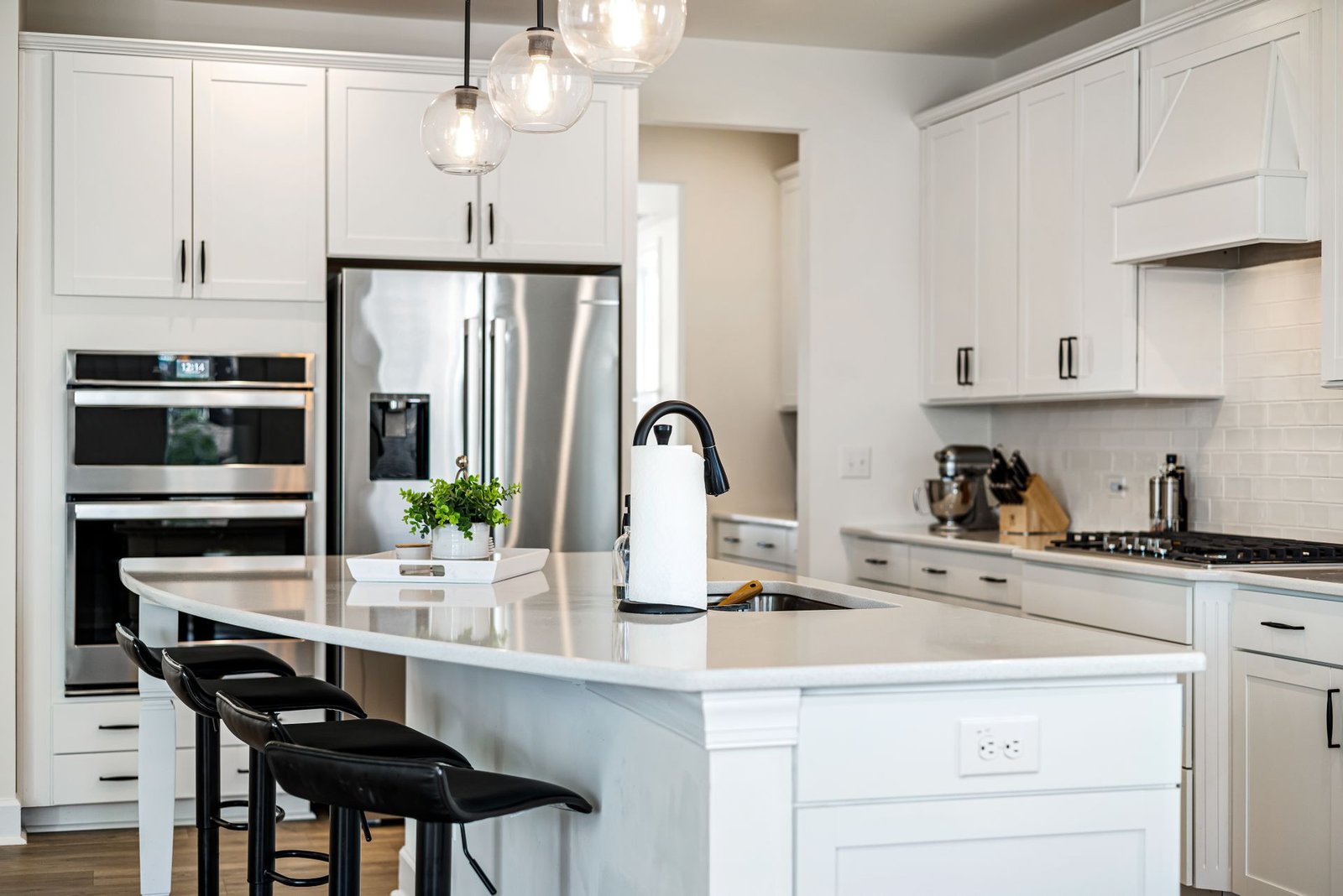
Kitchen Island Decor: Easy Ideas to Style Your Island Like a Designer
Good kitchen island decor follows one simple rule: style one-third of the island and keep two-thirds clear. That habit keeps the island beautiful and still usable for cooking, homework, and morning coffee. This guide shows you how — pendant lights at the right height, stools that fit, a centrepiece that works, and colour that ties the room together.
Start With the One-Third Rule
Before you buy a single vase, decide how much of the island gets styled. The rule designers use is simple: one-third styled, two-thirds clear. On a 6-foot island, that means about 2 feet of decor and 4 feet of open counter. Keep the styled third in one tight group — on a tray or a runner — so you can lift it away in one motion when you need the full surface.
Divide the island into zones. The working zone is the stretch nearest the stove or sink, where you chop and set down hot pans. The styled zone is the far half or one end. The seating zone is the side with the stools, where decor should stay low so it never blocks a conversation.
Leave 36 to 42 inches of clear floor space around the island so someone can walk past a pulled-out stool without turning sideways. If your island is new or you are still planning the room, floor plans help you see how it sits in the whole layout: our mansion floor plans show how designers place work zones and walking space around a large island. The island is also the first thing most guests see in the kitchen — our entryway decor guide uses the same first-impression thinking for the front of the home.
Hang Pendant Lights at the Right Height
Pendant lights are the single biggest decor decision above the island. They set the mood, light the work surface, and fill the empty air over the counter. Get the height and count right and the whole kitchen looks designed.
How High to Hang Pendants
Hang pendants so the bottom of the shade sits 30 to 36 inches above the countertop. That range works for a standard 8-foot ceiling and a 36-inch-high island. Lower than 30 inches and the shades block the view and glare in your eyes when you sit down. Higher than 36 inches and the light spreads too thin for task lighting. For a 10-foot ceiling, raise them to about 36 to 40 inches so they stay connected to the island.
Measure from the countertop up, not from the ceiling down. Check the height by sitting on a stool before you fix anything in place. The bottom of the shade should clear a seated person’s head by at least 6 inches. If the fixture is new or the ceiling box needs changing, hire a licensed electrician — do not wire a new fixture yourself.
How Many Pendants and How Far Apart
Two pendants suit an island up to about 7 feet long, and three suit a longer one. Space them 24 to 30 inches apart, centre to centre, and keep the outer pendants at least 6 inches inside the ends of the island. A single large pendant works on a small island up to 4 feet long, as long as it is no wider than the island’s depth minus 12 inches.
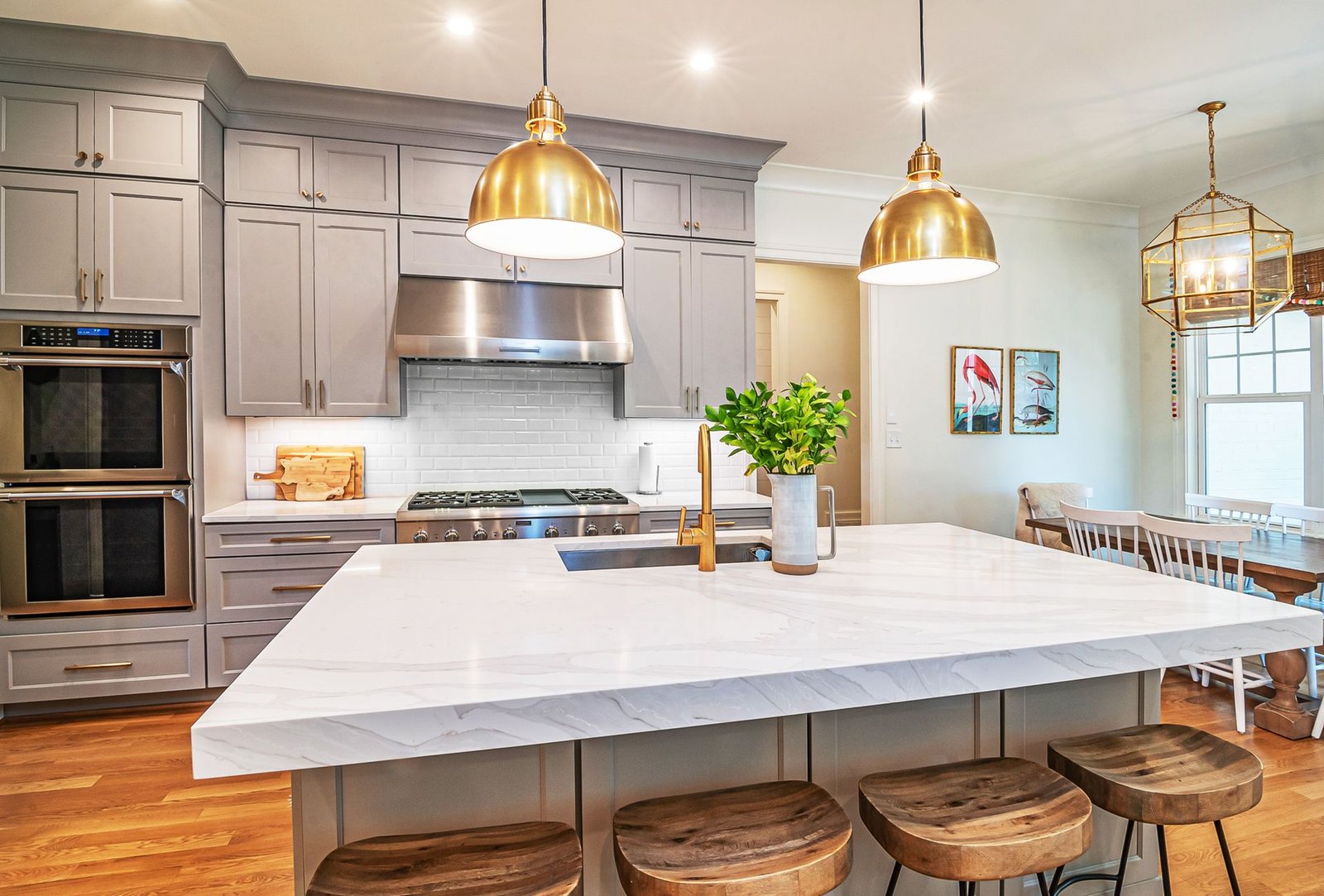
Size the shades to the island, not the room: a shade about one-third the width of the island beneath it. A 36-inch-wide island suits shades 12 to 18 inches across. Keep all the pendants in a row at exactly the same height — three shades at three slightly different heights is the mistake every designer notices in half a second. Warm bulbs around 2700K make the kitchen feel inviting in the evening, and a dimmer lets the same lights work for chopping at noon and dinner at night.
Pick Stools That Fit the Island
Bar stools decide how people actually use your island. The island has become the home’s gathering spot — designers now point to the kitchen island as the home’s gathering spot for dining, working, and socializing — and the stools are what make that gathering comfortable.
Fit comes first. Match the stool to the counter height, allow enough width per seat, and leave room for knees.
| Island height | Stool seat height | Best for |
|---|---|---|
| 36 inches (standard counter) | 24 to 26 inches | Most kitchen islands, breakfast seating |
| 42 inches (bar height) | 28 to 30 inches | Raised bar sections, taller islands |
| 30 inches (table height) | 18 to 20 inches | Low islands used as a dining table |
Leave about 24 inches of counter length per stool so elbows do not bump, and pick a seat height that leaves 10 to 12 inches between the seat and the underside of the counter. A seating overhang of about 12 inches gives knees room. For a standard 6-foot island, three stools fit comfortably — four will squeeze in on paper but not in practice.
Choose the stool style after the fit. Wood suits a farmhouse island, metal suits an industrial one, and upholstered seats add comfort for long breakfasts. A swivel seat lets guests turn and talk, and a backrest matters if anyone sits for more than fifteen minutes. With small children, pick wipeable seats — leather, vinyl, or washable fabric. Keep the colour in the kitchen’s palette: pull it from the island base, the pendant finish, or the hardware.
Build a Centrepiece That Works
The centrepiece is the island’s anchor. Build it from one strong piece rather than a scatter of small ones, and keep it inside the styled third. The best ones look intentional from every side, because people walk around the island and sit on both sides.
The Tray Method
Start with a tray. A rectangular wooden, marble, or woven tray, roughly 18 by 12 inches, gives smaller items a defined home so the island reads styled instead of scattered. It also makes the whole display moveable: when you need the counter for a big meal, you lift one tray instead of six separate objects. Place it slightly off-centre so it does not block sightlines.
Follow a low-to-high arrangement inside the tray: a low ceramic bowl or linen napkins, a medium cookbook stack or small container, and a high vase or tall branches. That gentle rise is easier to look at than a row of same-height objects. Group in odd numbers — three often looks natural — and stick to two or three colours from the room. Leave empty space around the grouping; empty counter is what makes the centrepiece stand out.
Five Centrepiece Formulas That Always Work
If you are unsure where to start, copy one of these. Each one fits on a tray and lifts away in seconds.
- A fruit bowl that changes weekly. A wide, shallow bowl, 12 to 14 inches across, filled about two-thirds full. Use one fruit in quantity — a bowl of only lemons reads as a design decision. Lemons in spring, apples in fall, oranges in winter.
- Fresh flowers or tall branches. One tall vase with flowers or eucalyptus gives the island height and a centre the eye can find from the door. Keep it tall rather than wide, around 18 to 24 inches. If a cat shares your home, skip lilies — every part is seriously toxic to cats — and use tulips or eucalyptus instead.
- Cutting boards and fresh herbs. Lean two or three wooden cutting boards against the backsplash, and add a small pot of basil, mint, or parsley. It is decor you actually use.
- Cookbooks and a potted herb. A short stack of two or three cookbooks adds colour, especially if the covers match your kitchen palette. Top the stack with a small potted herb. Our home library ideas guide shows how built-in shelves hold books without crowding a room — the same thinking works for the two or three cookbooks that earn a place on the island.
- One sculptural object. In a modern kitchen, restraint is the styling strategy. Choose one sculptural object — a handmade ceramic bowl, a curved stone vase, or a matte black pitcher with bare branches — and give it room to breathe on an otherwise clear island.
Colour and Contrast: Make the Island Stand Out
Colour is what turns an island from a counter into a feature. Two approaches work: make the island the bold piece with a deep cabinet colour, or keep it tone-on-tone with the perimeter cabinets and let texture carry the design.
A contrasting island is the fastest way to make the kitchen feel designed. Deep navy, forest green, or charcoal on the island base, with white or light perimeter cabinets, gives the room a clear focal point. For more ways to use contrast, see these contrasting kitchen island ideas from Better Homes & Gardens. A bold island works best when the countertop stays quiet — plain quartz or butcher block — so the colour, not the stone, does the talking.
One Bold Colour or Two?
Start with one bold colour on the island base. A second accent can come from the stools, the pendant finish, or a runner, but two strong colours on the island itself usually fight each other. If the island is already bold, keep the centrepiece calm — white ceramics, wood, and greenery — so the island colour stays the star.
Borrow Colour From the Room
The easiest way to make island decor feel cohesive is to borrow colours already present in the room. Pick two or three from the existing palette — the backsplash, the cabinet hardware, the dining chairs — and repeat them in the island accessories. A light, airy palette suits a coastal kitchen: our beach house floor plans show how light colours and open flow work together, and the same pale blues, whites, and natural wood translate to island styling. Wall finish matters too — our decorating a dining room wall guide shows how the right treatment can make a plain wall feel finished. Repeat each material twice so it looks deliberate — brass pendants with brass pulls, rattan stools with a woven basket — and add one washable runner for softness.
Keep It Usable: The Daily Reset
An island only stays styled if the styling survives real life. The habit is the daily reset: once a day, usually while the kettle boils, put the island back to its styled state. Anything that landed there wrong — mail, school papers, a stray mug — goes home. The reset takes two minutes.
Design for easy relocation. Keep the centrepiece light enough to lift with one hand, or on a tray you can slide aside. A heavy stone bowl that never moves becomes an obstacle; a tray that slides becomes part of the workflow. If children do homework at the island, keep the styled third at the far end and the seating end clear — the same rule applies if the island doubles as a laptop spot.
Two safety notes. Use flameless LED candles around children and pets — the same warm glow with zero fire risk. Skip scented candles if you cook often, because the smell mixes with food aromas. A small plant or a bowl of fruit scents nothing and still looks finished.
Worked Example: A 7-Foot Island Styled for $310
Take a 7-foot island with a white quartz top and navy base cabinets, in a family kitchen in Ohio. The owners want it styled but still usable for breakfast and homework. These are example prices, not a quote — shop your own stores and the total will move a little either way.
| Item | What it does | Example cost |
|---|---|---|
| Wooden tray, 18 by 12 inches | Holds the centrepiece | $45 |
| Ceramic vase with eucalyptus branches | Tall element, adds height | $40 |
| Wide fruit bowl, wood | Low element, fruit display | $32 |
| Two cookbooks | Medium element, adds colour | $35 |
| Washable linen runner | Soft layer, defines the styled third | $28 |
| Two small herb pots, basil and mint | Living green | $18 |
| Candle trio, flameless LED | Evening glow | $32 |
| Two leaning cutting boards | Warm wood, used daily | $45 |
| Linen napkins, set of four | Soft colour | $15 |
| Small potted plant | Extra green | $20 |
| Total | $310 |
The styling took one afternoon: runner first, then the tray with the vase, bowl, and cookbooks, then the herb pots and cutting boards at the far end. The island still seats three at breakfast, and the centrepiece lifts away on its tray when the family needs the full counter.
Mistakes to Avoid When You Decorate a Kitchen Island
- Styling the whole island. A centrepiece across the entire surface leaves no room to cook. Style one-third, keep two-thirds clear.
- Pendants hung too high or too low. Below 30 inches they block the view; above 36 inches they stop lighting the work surface. Measure from the countertop up.
- Stools that do not fit. The wrong seat height, or four stools squeezed into a three-stool island, makes every meal uncomfortable.
- Too many small objects. Five or six tiny accessories read as clutter. One tray, three objects, two or three colours.
- A centrepiece you cannot move. If it takes two hands and three trips to clear the counter, it will not survive a real dinner.
- Matching everything. A kitchen where the tray, vase, stools, and pendants all match looks like a showroom. Mix one or two materials and let the rest vary.
- Forgetting the seating side. Decor piled on the seating half blocks conversation and elbows. Keep the seating side low and clear.
Frequently Asked Questions
How much of a kitchen island should you decorate?
Style about one-third and keep two-thirds clear. Group the styled third in one tight cluster — on a tray or a runner — so it lifts away in one motion. On a 6-foot island, that is about 2 feet of decor and 4 feet of open counter.
How high should pendant lights hang over a kitchen island?
Hang pendants so the bottom of the shade sits 30 to 36 inches above the countertop — that range works for a standard 8-foot ceiling and a 36-inch-high island. For a 10-foot ceiling, raise them to about 36 to 40 inches. Keep all pendants in a row at exactly the same height.
What size stools do I need for a kitchen island?
For a 36-inch island, choose counter stools with a seat height of 24 to 26 inches. For a 42-inch island, choose bar stools at 28 to 30 inches. Allow about 24 inches of counter per stool, and leave 10 to 12 inches between the seat and the underside of the counter.
How do I keep a kitchen island centrepiece from looking cluttered?
Group objects in odd numbers, vary their heights, and stick to two or three colours. Put the group on a tray so it reads as one unit, and leave empty space around it. If it spreads across the whole island, remove one or two pieces.
What should I put on a kitchen island every day?
A fruit bowl, a tray with a vase or a small plant, and one or two practical items you actually use — cutting boards, a cookbook stack, or an olive oil bottle. Those staples look styled, stay useful, and reset in two minutes each morning.
A Styled Island Starts With One Tray
Kitchen island decor is not about filling the counter — it is about one spot, one tray, and three objects that belong together, then leaving the rest of the island alone. Hang the pendants at the right height, pick stools that fit, borrow colour from the room, and reset the island once a day. Swap the centrepiece with the season — citrus and fresh flowers in spring, dried branches and brass in fall — and use the same approach outside: our front porch decor ideas guide shows how. If your island doubles as your daytime desk, see our guides to how to build a home office and how to create a functional home office for the workspace side of the same room.
Disclaimer: This guide shares general home decor information for planning purposes. Costs, sizes, and product availability vary by location and store, and every kitchen is different. Hire a licensed electrician for new light fixtures or wiring work, and get local professional advice before you change anything structural or electrical in your kitchen.