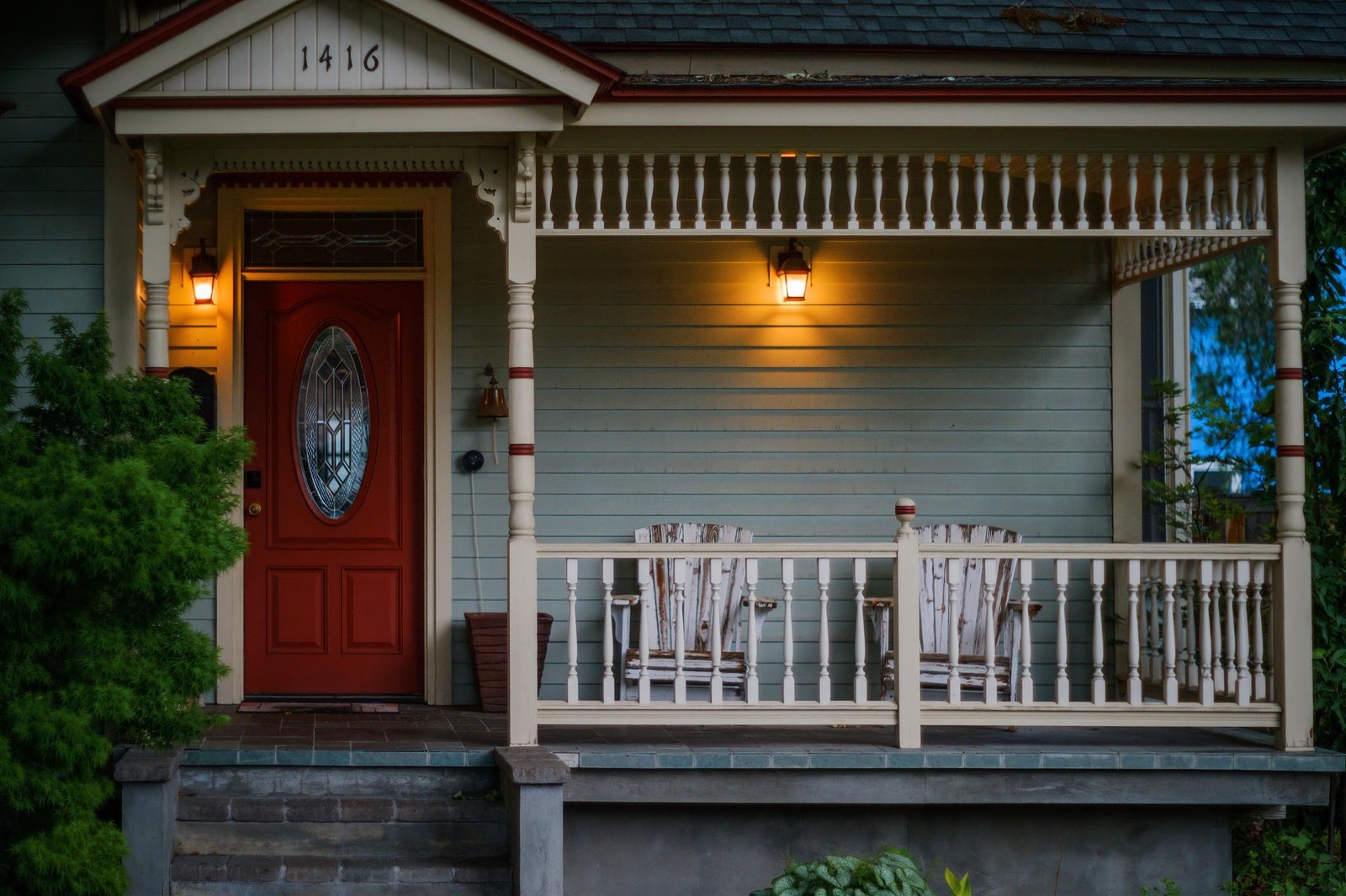
Front Porch Decor Ideas: Easy Ways to Style a Welcoming Entry
A front porch becomes welcoming when three things work together: seating you can actually sit on, plants that stay alive outside, and light that makes the entry glow after dark. Get those three right and the rest is garnish.
You do not need a big porch or a big budget. Most ideas below cost little, use weather-proof pieces, and work on a porch as small as a single step. For the wider picture of porch styles and layouts, see our guide to porch ideas.
What Makes Front Porch Decor Work
Good porch decor follows three simple rules. First, scale: every piece should fit the porch, not fight it. A deep porch can hold a swing and two chairs; a narrow stoop can hold one chair and a single planter. Second, weather: anything that lives outside must handle rain, sun, and wind, or you will replace it every season. Third, one focal point: pick one thing the eye lands on first — usually the front door — and let everything else support it.
Measure before you shop. A porch that is 6 feet deep fits chairs and a small table; a porch 4 feet deep fits a bench against the wall and not much else. Carry those numbers with you so you do not buy a loveseat for a stoop.
Start With Seating That Invites People to Sit
Seating is the heart of front porch decor, because a porch with nowhere to sit is just a walkway. The classic choices are rocking chairs, a bench, or a porch swing, and each one sets a different mood.

Rocking chairs are the safest pick for most porches. Two chairs angled slightly toward the street, with a small table between them, read as an invitation. Choose chairs made for outdoors — painted wood, resin wicker, or metal — and skip indoor cushions that soak up rain. Outdoor cushions with removable, washable covers last far longer.
A porch swing is the most charming option, but it needs the most room and the most care. It needs at least 3 feet of clearance in front and behind to swing safely, plus a ceiling beam strong enough to hold it. If you are unsure about the beam, ask a licensed professional before you hang anything heavy. A porch that wraps around the house has room for two seating zones — one social stretch by the door and one quiet stretch around the side — and our guide to wraparound porch ideas shows how to use that extra space.
Planters and Greenery That Survive Outside
Plants do more for a front porch than almost anything else. They add colour, soften hard edges, and make a plain porch feel alive. The trick is choosing plants that match your sun and your habits.
Start with two planters flanking the front door. Matching pots on each side frame the entry and give the porch instant symmetry. Use pots heavy enough not to blow over — concrete, thick ceramic, or resin with a brick at the bottom. Light plastic pots tip in the first strong wind.
For the plants themselves, match the light. A sunny porch suits geraniums, petunias, lantana, and herbs like rosemary. A shady porch suits ferns, hostas, impatiens, and coleus. If you forget to water, choose drought-tough plants like succulents, ornamental grasses, or a small boxwood topiary.
Hanging baskets add height without taking floor space. Hang one on each side of the door and keep them high enough that tall guests will not bump their heads. Water them more often than ground planters — they dry out fast in wind and sun.
A simple rule for planters: thriller, filler, spiller. One tall plant in the middle for height, medium plants around it for fullness, and one trailing plant over the edge to soften the pot. That one formula makes almost any planter look like a designer arranged it. The back porch gets the same treatment, and our back porch ideas guide shows how greenery works there too.
Lighting That Makes Evenings Better
A porch that goes dark at sunset loses half its use. Good porch lighting has three layers: a light by the door so guests can find the handle, warm light over the seating so people can stay after dark, and a little sparkle for mood.
String lights are the easiest way to add evening charm. Drape them along the porch beam, around a railing, or in a loose swag across the ceiling. Solar-powered sets work well if the porch gets direct sun during the day; plug-in sets are steadier if it does not. Bob Vila tested dozens of sets and picked the best outdoor string lights for different porches, so see their best outdoor string lights guide before you buy. If you want the seating area to feel like a real outdoor room after dark, our guide to outdoor fireplace ideas shows how firelight and seating work together.
Lanterns on the floor or steps add a soft glow at ankle height. Use battery candles or LED lanterns rather than real flames — a real candle on a wooden porch is a fire risk, and wind blows it out anyway. One large lantern beside the door beats five small ones scattered around.
Rugs and Doormats: The Layered Welcome
The floor is the most overlooked part of front porch decor, and the easiest to fix. A rug defines the seating area, adds colour, and keeps feet off a cold or rough floor.
The layered look works on almost every porch: a larger outdoor rug underneath, with a smaller coir doormat on top. The rug should be big enough to sit under the front legs of the chairs — a 3-by-5-foot rug fits most small porches, while a 5-by-7 fits a deeper one. Leave a few inches of bare floor showing around the edges so the rug looks placed, not wall-to-wall.
Choose rugs made for outdoors: polypropylene, jute treated for outdoor use, or recycled plastic. Indoor rugs hold water, grow mildew, and fade in a month. An outdoor rug should dry fast after rain and hose clean in spring.
The doormat does the dirty work. Coir mats scrape shoes well and handle weather, while a rubber-backed mat stays put in wind. Replace the mat when the fibres flatten or the corners curl — a curled mat is a tripping hazard. If your porch floor is concrete or pavers rather than wood, the same rug rules apply, and our guide to what is a patio explains how outdoor floor surfaces behave in weather.
Wreaths and Door Decor
The front door is the focal point of the porch, so it deserves the most attention. A wreath is the simplest way to dress it, and the size matters more than the style. For a standard 36-inch door, choose a wreath 24 to 28 inches across — about two-thirds of the door width. A wreath that is too small looks lost; one that is too big crowds the panels and swings in the wind.

Change the wreath with the seasons and the porch stays fresh all year. Spring brings fresh greenery and pastel blooms; summer brings eucalyptus or boxwood; fall brings dried leaves, wheat, and small pumpkins; winter brings evergreen, pinecones, and a red ribbon.
The door itself is decor too. A fresh coat of paint on the front door is the cheapest big change you can make to a porch. Navy, deep red, black, and sage green all work with most house colours, and a painted door makes every other piece on the porch look more deliberate. If you paint, use exterior paint rated for doors, and paint on a dry day so it cures properly. The welcome continues inside the door, and our entryway decor guide has ideas for small entries that stay tidy.
House numbers are the finishing touch people forget. Oversized numbers, mounted at eye level beside the door, look intentional and help guests and delivery drivers find you. Choose a finish that matches your sconces or door hardware — mixed metals look accidental.
Colour Schemes That Tie It Together
A porch looks pulled together when it uses one colour scheme, not a little of everything. Pick three colours at most: one main, one supporting, and one accent.
Classic white and green never fails: white furniture and trim, green plants, and one dark accent like black lanterns or a navy door. It suits farmhouse, colonial, and coastal homes alike, and it photographs well in every season.
Coastal blue and white feels fresh and calm: pale blue cushions, white wicker, natural wood, and a sandy rug. It works best on homes with light siding, and it pairs well with the pale, weathered look of a modern farmhouse exterior.
Bold door, quiet porch is the easiest scheme of all: paint the door a strong colour — red, teal, yellow — and keep everything else neutral. The door becomes the whole focal point, and you can change the look next year with one can of paint. Before you commit to a colour, test it in real daylight, as our guide to house exterior colors explains.
Decorating for the Seasons
A porch that changes with the seasons never looks tired, and the changes can be small. Keep the big pieces — chairs, rug, lanterns — the same all year, and swap only the small, cheap pieces.
Spring is the lightest swap: fresh potted flowers, a pastel wreath, and a clean doormat after winter. Wash the furniture and the rug, and the porch wakes up with the garden.
Summer is the fullest season: more plants, brighter cushions, and the string lights on every evening. Add a small outdoor fan if the porch gets hot — moving air makes a porch usable on the warmest days.
Fall is the warmest look: mums in the planters, pumpkins by the steps, a harvest wreath, and a plaid throw on the bench. Use real pumpkins and mums rather than plastic ones; they cost about the same and look far better.
Winter is the simplest: evergreen branches in the planters, a full wreath, warm lanterns, and a sturdy doormat for wet boots. Skip anything fragile that snow and ice will ruin.
Small Front Porch Decor Ideas
A small porch needs fewer pieces, chosen better. The most common mistake is cramming in too much — five small items look cluttered, while two well-chosen items look intentional.
Start with the door and one planter. A painted door and a single large planter beside it can carry a whole small porch. Add a doormat, and you are done. If there is room for one chair, choose a slim one — a folding bistro chair or a narrow bench — and skip the table.
Go vertical when the floor is full. A hanging basket, a wall-mounted lantern, and a wreath all decorate without taking floor space. A tall, narrow planter by the door adds greenery in a footprint smaller than a doormat.
Keep the palette to two colours on a small porch. Two colours read as calm; four colours read as crowded. The Spruce has a whole gallery of small porch ideas that cost very little, and their small porch ideas on a budget roundup is a good place to borrow a look for a tight space.
Measure the walkway before you add anything. Guests need at least 3 feet of clear path from the steps to the door. If a planter or chair narrows that path, move it. A porch that is hard to walk across is not welcoming, no matter how pretty it looks from the street.
Luxury Touches on a Budget
A porch can look expensive without an expensive budget. Spend on the few things people touch and see up close, and save on everything else.
Here is a labeled example, not a quote. Imagine refreshing one average front porch with new decor, comparing a modest refresh with a fuller one.
| Item | Modest refresh (about $150) | Fuller refresh (about $600) |
|---|---|---|
| Seating | One outdoor pillow set, $40 | Two resin wicker rockers, $280 |
| Planters | Two terracotta pots + plants, $45 | Two heavy ceramic planters + topiary, $140 |
| Lighting | One solar string light set, $25 | Two lantern sconces + string lights, $110 |
| Rug and mat | Layered coir mat over existing rug, $25 | New outdoor rug + layered mat, $55 |
| Door decor | Fresh wreath, $15 | Painted door + wreath + house numbers, $15 |
| Example total | About $150 | About $600 |
The modest refresh changes the whole feel of the porch for the price of one dinner out. The fuller refresh replaces the furniture itself, which is the only item worth spending real money on — chairs are the piece guests touch, sit on, and remember. Everything else can be swapped cheaply next season.
Three cheap upgrades punch above their price: a painted front door, a full wreath sized to the door, and matching planters flanking the entry. Do those three first, and the porch already looks like someone designed it.
Mistakes to Avoid With Front Porch Decor
Too many small items. Five tiny decorations look like clutter. Two or three larger pieces look deliberate. When in doubt, take one thing away.
Indoor furniture outside. An indoor armchair or a fabric sofa will soak up rain, grow mildew, and sag within a season. If a piece is not rated for outdoor use, it does not belong on the porch.
Blocking the path. Decor should frame the walkway, never narrow it. Keep at least 3 feet clear from the steps to the door, and keep the steps themselves free of pots and lanterns.
Ignoring the ceiling. A bare ceiling makes a porch feel unfinished. A painted ceiling, a hanging lantern, or a row of string lights finishes the room overhead.
One-season thinking. Buying decor that only works in summer means starting over in fall. Choose the big pieces in neutral colours and let the small seasonal pieces do the changing.
Forgetting the night. A porch decorated only for daylight goes dark and dead at sunset. Even one lantern or a short string of lights keeps the welcome going after dark.
Frequently Asked Questions
How do I decorate my front porch on a budget?
Start with a painted front door, a full wreath sized to the door, and two matching planters flanking the entry. Add a layered doormat and a string of lights, and the whole refresh can cost about $150. Spend more only on seating, because chairs are the piece guests actually use.
What should I put on a small front porch?
Less than you think. A painted door, one large planter, and a doormat can carry a small porch on their own. If there is room, add one slim chair or a narrow bench. Go vertical with a hanging basket and a wall lantern so nothing eats floor space, and keep the walkway at least 3 feet clear.
How do I make my front porch look welcoming?
Make the door the focal point with a wreath and a painted door, flank it with matching planters, add seating that faces outward, and light it warmly after dark. Keep the path clear and the palette to three colours at most. A porch that is easy to walk onto, easy to sit on, and softly lit at night reads as welcoming to everyone.
What plants are best for a front porch?
Match the plant to the sun. Sunny porches suit geraniums, petunias, lantana, and rosemary. Shady porches suit ferns, hostas, impatiens, and coleus. If you forget to water, choose boxwood topiary, succulents, or ornamental grasses. Use heavy pots so wind does not tip them.
How do I decorate my front porch for each season?
Keep the big pieces the same all year and swap only the small ones. Spring: fresh flowers and a pastel wreath. Summer: brighter cushions and string lights every evening. Fall: mums, pumpkins, and a harvest wreath. Winter: evergreen branches, a full wreath, and warm lanterns.
A front porch does not need to be big or expensive to feel welcoming. Start with the door, add seating you can sit on, plants that stay alive, and light that glows after dark, and keep the palette to three colours. For more ways to enjoy the space outside your front door, see our guides to outdoor living space ideas and small backyard ideas.
Disclaimer: This article shares general home information for planning and decorating purposes only. Every home, porch, climate, and budget is different, so costs and results will vary. Check product labels for outdoor use before placing items outside, and hire a licensed local professional for any electrical, structural, or load-bearing work.