

Outdoor Fireplace Ideas: Types, Costs, and How to Choose One
An outdoor fireplace is a permanent, upright structure with a firebox and a chimney that turns a patio or yard into a place you can use on cool evenings. It faces one direction, blocks wind, and gives your seating area a clear focal point.
Most outdoor fireplaces cost $3,000 to $15,000 installed, with a national average of about $7,500. The right choice depends on your budget, your yard size, local rules, and whether you want wood or gas.
What Is an Outdoor Fireplace?
An outdoor fireplace is a built structure, not a portable fire bowl. It has a firebox where the fire burns, a hearth in front of it, and a chimney that carries smoke up and away from the people sitting nearby. It is usually made of stone, brick, stucco, or concrete, and it sits on a concrete footing or patio slab.
A fireplace is different from a fire pit. A fire pit is low, open, and round, and people sit in a circle around it. A fireplace is tall and faces one way, so people sit in rows facing the fire. The chimney is the key difference: it pulls smoke upward instead of letting it drift across the seating area. Kits are faster and cheaper; custom builds cost more but match your house and yard. For background on stone and paved areas, read our guide to what is hardscaping.
Outdoor Fireplace vs. Fire Pit
The first decision is usually fireplace or fire pit. Both give you warmth and a place to gather, but they suit different yards and budgets.
| Feature | Outdoor fireplace | Fire pit |
|---|---|---|
| Typical installed cost | $3,000 to $15,000 | $300 to $4,500 |
| Seating layout | Rows facing the fire | Circle around the fire |
| Smoke | Chimney carries it up and away | Drifts with the wind |
| Permit | Usually required | Sometimes required |
| Best for | Small yards, focal point, four-season use | Large yards, casual groups, lower budget |
A fireplace costs far more because you pay for a foundation, masonry, and a chimney that draws smoke correctly. If your budget is under $2,000, a fire pit is the realistic choice. If you want a permanent feature that anchors the patio and works when the wind picks up, a fireplace earns its higher price. A fireplace suits two to six people, while a fire pit suits a larger circle, and a chimney keeps smoke off nearby patios. See our guide to outdoor living space ideas for the wider yard plan.
Wood-Burning or Gas? How to Choose
Before you decide anything about fuel, note the safety boundary. A gas fireplace needs a gas line, and a gas line must be installed by a licensed professional, with a permit and an inspection. Do not run a gas line yourself, and do not connect a gas burner to an existing line without a professional checking it first. A wood-burning fireplace needs a chimney built to code height, and a chimney that draws badly can send smoke back into the seating area.
Wood-burning fireplaces give you the classic experience: crackling logs, real wood scent, and a tall, lively flame. You need dry, seasoned wood stored somewhere, you need to clean out ash, and smoke can bother neighbors. Some towns restrict wood burning during certain seasons or ban it outright, so check your local rules first.
Gas fireplaces light with a switch or a key, burn cleanly with no smoke or ash, and turn off just as fast. That convenience matters: you will light a gas fireplace on a cool Tuesday evening when you would never bother building a wood fire. Gas costs more up front if you have no outdoor gas line, and it is often allowed where open wood fires are restricted by burn bans. A middle option is a wood-burning fireplace with a gas starter, which lights the logs for you. It adds cost and still needs a licensed gas connection. Bob Vila’s guide to building an outdoor fireplace covers the same cost and design decisions.
How Much Does an Outdoor Fireplace Cost?
A small prefab unit and a large custom stone fireplace are almost different projects. The ranges below are typical US figures reported in 2026 cost guides, and they will vary by region, material, and labor rates. Always get two written estimates from local contractors before you commit.
| Fireplace type | Typical installed cost |
|---|---|
| Prefab steel unit | $1,500 to $4,500 |
| Modular stone kit | $3,500 to $6,500 |
| Custom brick fireplace | $6,000 to $10,000 |
| Natural stone, custom | $8,000 to $15,000 |
The national average reported by CostToRenovate is about $7,500: budget around $3,400, mid-range around $8,800, premium around $20,000.
Here is a worked example for a common mid-range project. This is an example scenario, not a quote: a 5-foot-wide masonry fireplace with manufactured stone veneer, a simple mantel, a gas log set, and a patio hearth extension.
| Item | Example cost |
|---|---|
| Materials (stone veneer, firebox, mantel) | $4,500 |
| Labor (mason and helper) | $3,500 |
| Gas line and log set | $500 |
| Permit and inspection | $300 |
| Total, example mid-range project | $8,800 |
A gas line can add $300 to $2,000, and a full masonry chimney can add $1,500 to $5,000. A chiminea, the small portable clay or metal fireplace with a narrow chimney, costs $150 to $500 and is the cheapest way to test whether you enjoy an outdoor fire before committing to a permanent build.
Stone, Brick, Stucco, and Concrete: Materials That Shape the Look
Match the material to your house, because it sets the style of the whole patio.
Stacked stone is the most popular choice. It suits traditional, rustic, and mountain-style homes, and its rough texture hides soot and weathering well. Natural stone costs more than manufactured stone veneer, which gives a similar look for less money. Stone is heavy, so it needs a solid footing and a mason.
Brick gives a timeless, tidy look that suits colonial, craftsman, and traditional homes. It is uniform, easy to match to a brick house, and ages well. A brick fireplace is usually cheaper than natural stone, and repairs are straightforward.
Stucco suits Mediterranean, Spanish-style, and modern homes, giving a smooth surface you can paint to match the house. It needs a sound structure underneath it and more upkeep than stone in wet climates.
Concrete and blackened steel suit modern and contemporary yards. A smooth concrete fireplace suits a modern patio, while a steel fireplace suits a smaller space. Whatever material you pick, the firebox itself must be lined with firebrick or a rated firebox insert: ordinary brick, stone, or concrete cannot take direct, repeated heat without cracking. If you are unsure what your firebox needs, ask a mason or a licensed professional before you build. For more material and layout combinations, browse our collection of hardscape ideas.
Outdoor Fireplace Ideas for Different Yards and Styles

A fireplace works best when it is designed with the seating, not added after it. These ideas cover the most common yards and styles.
Classic stone fireplace with built-in seating. A stacked-stone fireplace with a low seating wall on each side turns the patio into an outdoor room. The walls give people a place to sit and make the fireplace feel like part of the patio.
Modern linear gas fireplace. A long, low, horizontal firebox set into a smooth stucco or concrete wall suits a contemporary patio. A 48- to 60-inch flame suits a sofa better than a small square box, and the clean line keeps the focus on the seating, not the chimney. HGTV’s collection of outdoor fireplace ideas shows this style alongside rustic stone and brick designs.
Covered patio fireplace. A fireplace under a roof lets you use the patio in rain and extends the season by months. This is the one design where professional help is not optional: the chimney, the venting, and the clearances between the firebox and the roof structure must be checked by a licensed professional before anything is framed. See our guide to a covered patio attached to house for roof and layout ideas.
Small-yard fireplace. A narrow steel fireplace or a compact corner unit fits a townhouse patio or a small backyard. Set it on noncombustible paving, keep cushions outside the hot zone. Our small backyard ideas cover compact patios like this one.
Where to Place It: Size, Clearance, and Seating Layout
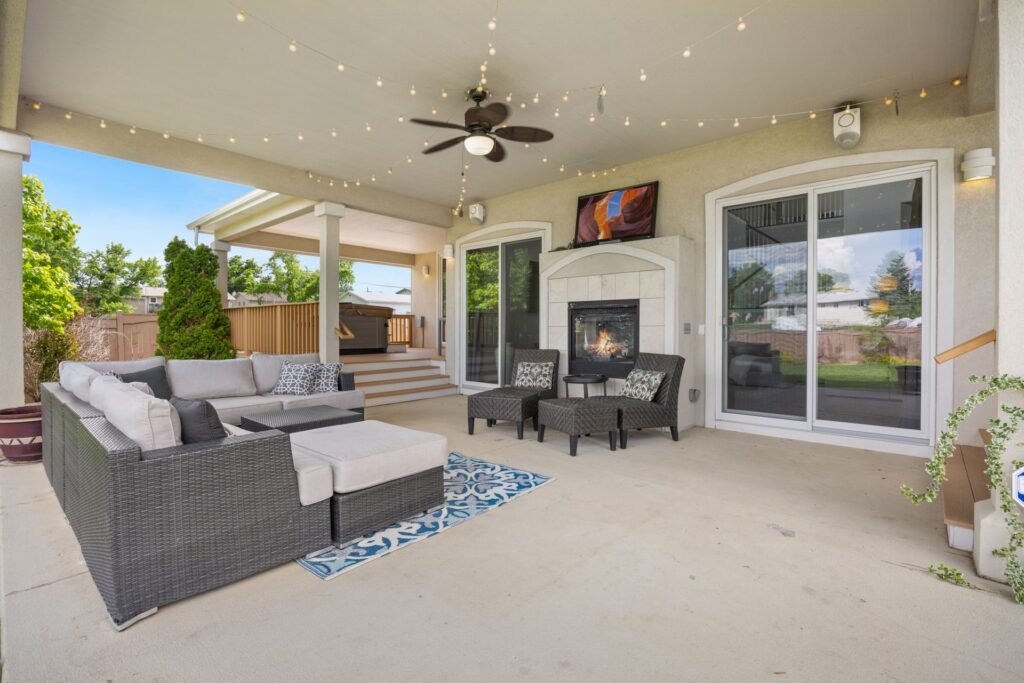
Placement decides whether the fireplace feels comfortable or awkward, so plan it before you order materials.
Start with the seating. A pair of lounge chairs works in roughly 8 by 10 feet, but a sofa with two chairs and a hearth wants closer to 12 by 16 feet. Walk the space before you commit: is the fire close enough to feel warm, and placed so nobody has to walk across the hearth to reach a chair?
Keep the fireplace at least 10 feet from the house, from other structures, and from overhanging trees, unless a licensed professional and your local code say otherwise for your specific design. The chimney should rise at least 2 feet above any structure within 10 feet, so smoke clears the roofline instead of drifting back down. The hearth should extend about 16 inches in front of the firebox and 8 inches to each side, giving you a safe surface where embers can land.
Face the fireplace away from the wind when you can, so smoke blows away from the seats rather than across them. Set it on a solid, noncombustible surface: a concrete slab or a paver patio is the standard choice. A gravel base can also work; our guide to a pea gravel patio explains the base and edging it needs. Never set a wood-burning fireplace on a wood deck.
What to Check Before You Build: Permits, Codes, and Safety
Finish this step before you spend money on materials. A permanent outdoor fireplace is a structure, and most towns treat it that way.
Check with your local building department first. Most areas require a permit for a permanent outdoor fireplace, plus a plan review, a setback check, and inspections of the foundation and the chimney. Ask whether wood burning is allowed, how far it must sit from the property line, and whether a gas line needs a separate permit.
Call 811, the national call-before-you-dig number, at least a few days before any digging. The service is free, and it marks underground utility lines so you do not cut a gas, water, or electric line. In many states it is required by law.
Hire a licensed professional for the gas line, the chimney, and the footing. A gas connection needs a permit, a pressure test, and an inspection, and a chimney must be built to the right height with the right flue size or it will not draw smoke properly. A full masonry fireplace is not a beginner DIY project. A prefab kit is the most DIY-friendly option, and even then, the gas and foundation work should go to a professional. Keep a fire extinguisher or a bucket of sand nearby, and never leave a fire burning unattended.
How to Maintain an Outdoor Fireplace
A small routine keeps a well-built fireplace safe and looking good.
For a gas fireplace, wipe the burner and any glass, check the ignition, and have a professional inspect the gas connection once a year. If you smell gas, turn it off and call a licensed professional right away. Do not try to fix a gas connection yourself.
For a wood-burning fireplace, clean out the ash after every few uses, and have the chimney checked and cleaned as needed to keep the draft healthy and soot in check. Look for cracks in the firebrick and the mortar each spring, and fix them before you light the first fire of the season: small cracks grow fast under repeated heat, and a cracked firebox is a safety problem, not a cosmetic one.
For all types, clear leaves from the hearth, check the chimney cap, and look for cracks or settling after winter. Planting around the fireplace softens the stone, and our low maintenance landscaping ideas focus on plants that need little watering or pruning.
💡 Practical Home Tip: Before you commit to a permanent fireplace, borrow or rent a portable chiminea and use it in the spot where your fireplace would go for two or three evenings. Watch where the smoke goes and whether the heat reaches your chairs. A few evenings with a portable chiminea tells you more about placement and wind than any drawing can.
Common Mistakes to Avoid
Building without a permit or a code check. An unpermitted fireplace can cause problems when you sell the house, and it can void insurance if something goes wrong.
Placing it too close to the house or a roof. Heat, embers, and smoke need clear space. A fireplace tucked under a low roof or against a wall without proper clearances is a fire risk, and fixing it later means rebuilding.
Skipping the footing. A heavy masonry fireplace on soft soil will settle, crack, and lean. A concrete footing, sized for your soil and climate, is not optional. In cold climates it must sit below the frost line, or winter will lift and crack it.
Forgetting the seating. A beautiful fireplace with nowhere comfortable to sit will not get used. Plan the chairs, the side tables, and the path to the back door at the same time as the fireplace, not after it is built. For seating ideas around a fire feature, browse our back porch ideas.
Frequently Asked Questions
How much does an outdoor fireplace cost?
Most outdoor fireplaces cost $3,000 to $15,000 installed, with a national average of about $7,500, based on 2026 US cost guides. A prefab kit runs $1,500 to $9,000 installed, while a custom masonry fireplace runs $6,000 to $20,000. A gas line can add $300 to $2,000, and permits usually run $50 to $500.
Do I need a permit for an outdoor fireplace?
In most areas, yes. A permanent outdoor fireplace is a structure, so most towns require a permit, a plan review, and inspections of the foundation and chimney. Check with your local building department before you buy materials, and check your homeowners association rules too.
Is a gas or wood-burning outdoor fireplace better?
Gas is better if you want convenience: it lights with a switch, makes no smoke or ash. Wood is better if you want the crackle, scent, and look of a real log fire. If you will use it often, gas usually wins, because you will light it on evenings when you would never build a wood fire.
How far should an outdoor fireplace be from the house?
Keep it at least 10 feet from the house, from other structures, and from overhanging trees, unless a licensed professional and your local code say otherwise. The chimney should rise at least 2 feet above any structure within 10 feet, and the hearth should extend about 16 inches in front of the firebox and 8 inches to each side.
Can I put an outdoor fireplace on a deck or under a covered patio?
Do not put a wood-burning fireplace on a wood deck. A fireplace under a covered patio is possible, but only when a licensed professional has checked the chimney, the venting, and the clearances between the firebox and the roof structure. Get the design approved before anything is framed.
Choosing Your Fireplace
An outdoor fireplace is a trade between cost and permanence. A fire pit is cheaper and simpler, but a fireplace gives you a chimney that carries smoke away, a wall that blocks wind, and a focal point that makes the patio feel like a room. If you will use it often, gas is the practical choice.
Confirm the permit, the setbacks, and the wood-burning rules in your area, then pick a size that fits your patio and a material that matches your house. Get two written estimates, hire a licensed professional for the gas line and the chimney.
Disclaimer: Homes, yards, budgets, and local codes vary, so treat the costs, sizes, and steps in this guide as general information rather than a fixed plan for your property. Before you build, check your local building codes and permit rules, and hire a licensed professional for gas lines, chimney work, footings, and any structural changes.


One Comment